Window mode follows your eyes with your camera, in this browser only: no picture or position leaves your device.
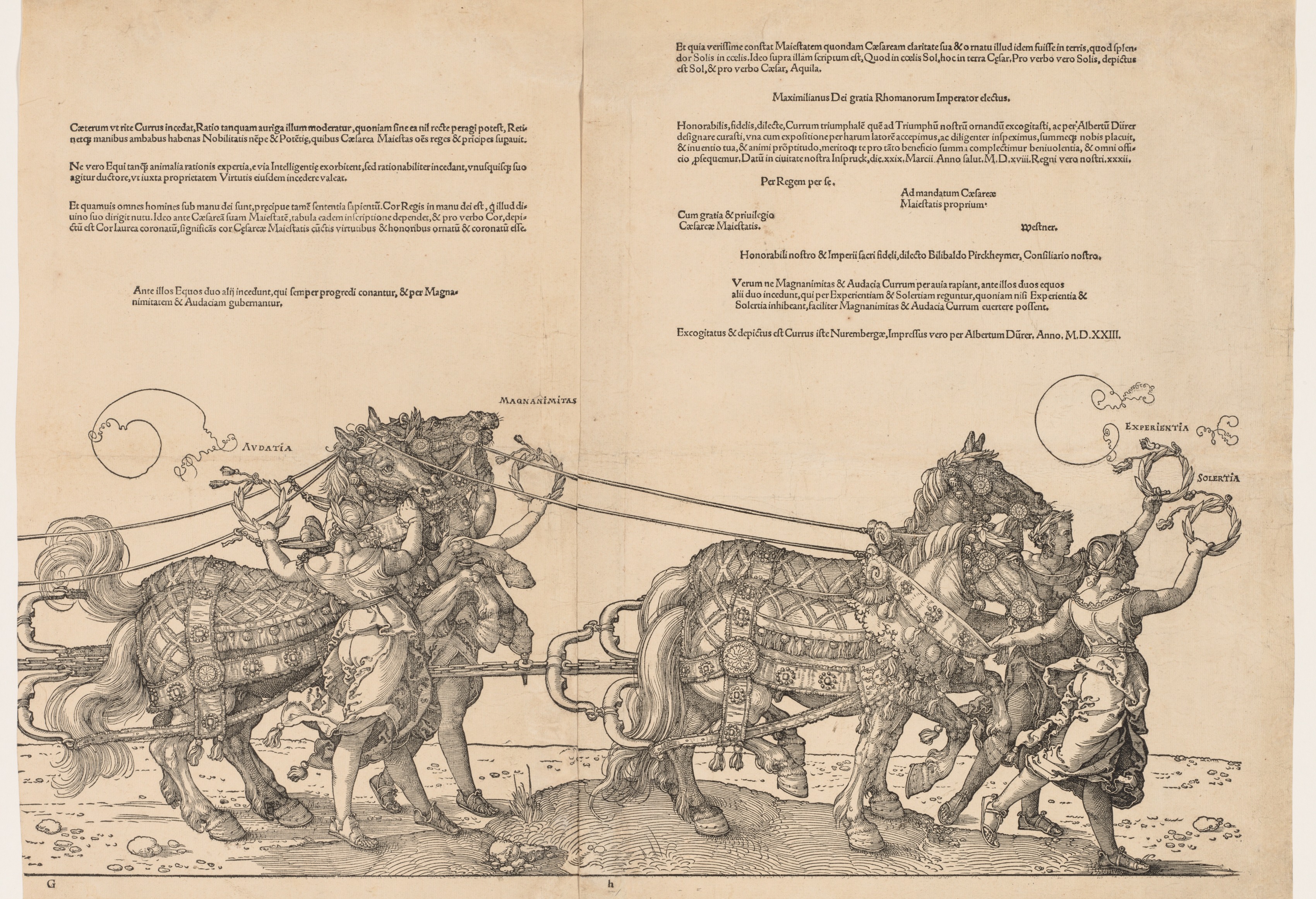
The Great Triumphal Car of Emperor Maximilian
Albrecht Dürer (German, 1471–1528)
c. 1523
- Medium
- woodcut
- Classification
- Culture
- Germany
- Museum
- Cleveland Museum of Art, Prints
- Credit line
- Dudley P. Allen Fund
- Rights
- Public domain (CC0), as the museum states it.
- Who can see it
- Teens profiles and older: its subject is for older viewers (war, death, the Passion, drink or the like). How works are placed
View at the Cleveland Museum of Art
About this work
Dürer conceived this fantastical chariot as part of a larger commission to depict Holy Roman Emperor Maximilian I (reigned 1486–1519) in a triumphal procession. The ruler sits enthroned in the lavish car, as Victory holds a laurel wreath above his imperial crown. Her feathered wings list Maximilian’s military campaigns. Nearly every component of the allegorical pageant—from the entourage of female attendants to the laurel garlands—has a Latin label describing honorable qualities of an ideal prince. The car rolls on wheels of Magnificence, Honor, Dignity, and Glory. Its driver is Reason, who guides a team of 12 horses with reins of Nobility and Power. Virtues of Justice, Strength, Wisdom, and Temperance, stand on pedestals arranged around the emperor. Maximilian died in 1519, before the ambitious commission could be completed. Dürer published The Great Triumphal Car at his own expense with text composed by his friend Willibald Pirckheimer (1470–1530).