Window mode follows your eyes with your camera, in this browser only: no picture or position leaves your device.
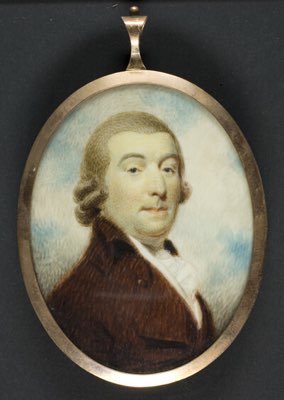
Portrait of Sandford Peacocke
William Wood (British, c. 1768–1809)
1801
- Medium
- watercolor on ivory in a gold frame with glazed reverse
- Classification
- Portrait Miniature
- Dimensions
- Framed: 8.6 x 7.3 cm (3 3/8 x 2 7/8 in.); Sight: 8 x 6.7 cm (3 1/8 x 2 5/8 in.)
- Culture
- England, early 19th century
- Museum
- Cleveland Museum of Art, Modern European Painting and Sculpture
- Credit line
- The Edward B. Greene Collection
- Rights
- Public domain (CC0), as the museum states it.
- Who can see it
- Tweens profiles and older: its subjects are known and suit older children. How works are placed
View at the Cleveland Museum of Art
About this work
William Wood worked primarily in London and exhibited over 100 miniatures at the Royal Academy, where he began his training at the age of 16. His portraits of men in particular are regarded as highly refined and remarkably sensitive psychological studies. While Wood is known to have copied miniatures by Richard Cosway (1742–1821), George Engleheart (1752–1829), and John Smart (1741–1811), his distinctive style can be observed in the network of small dots and dashes of paint that follow the contours of a sitter’s face. In addition to portrait miniatures, Wood executed a number of eye miniatures and became increasingly interested in watercolor landscapes during the years preceding his death in 1810. He signed his miniatures on the paper backing, often with the sitter’s name or initials, Wood’s studio location, and the year. The fact that the artist signed his work on the back rather than the front has contributed to making his miniatures harder to identify immediately, an issue complicated by his aptitude for imitating a variety of styles employed by his fellow miniaturists.
Historians have rare insight into Wood’s working process due to the survival of his four-volume ledger that…