Window mode follows your eyes with your camera, in this browser only: no picture or position leaves your device.
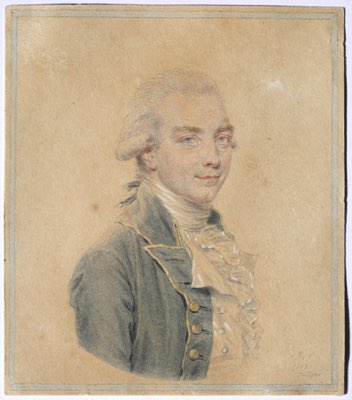
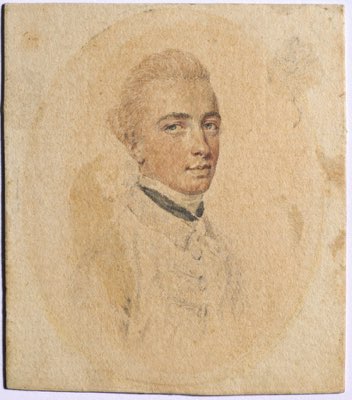
Portrait of an Officer
John I Smart (British, 1741–1811)
c. 1794
- Medium
- watercolor on ivory in a contemporary gold frame with plain back
- Classification
- Portrait Miniature
- Dimensions
- Framed: 6.5 x 5.4 cm (2 9/16 x 2 1/8 in.); Unframed: 6.4 x 5.4 cm (2 1/2 x 2 1/8 in.)
- Culture
- England, late 18th century
- Museum
- Cleveland Museum of Art, European Painting and Sculpture
- Credit line
- The Edward B. Greene Collection
- Rights
- Public domain (CC0), as the museum states it.
- Who can see it
- Tweens profiles and older: its subjects are known and suit older children. How works are placed
View at the Cleveland Museum of Art
About this work
The unknown sitter has powdered hair, brown eyes, a ruddy complexion, and facial hair stubble. He wears a red military coat with black facings, gold buttons, gold epaulet, a white waistcoat, and frilled cravat. His uniform identifies him as an Indian militia officer, though his precise rank cannot be determined since his left shoulder is not visible. The background is mottled gray. The red of the officer’s coat is also painted in red on the back of the ivory support. Back-painting was a process employed by miniaturists to heighten the brilliancy of certain colors, especially in a sitter’s costume and on the face to enhance bright eyes or pink lips and cheeks. John Smart did not back-paint all of his works, using the technique selectively in portraits in which he wished to achieve a particularly bright color that would show through the back due to the translucency of the thin ivory. The miniature is housed in a contemporary gold frame. This portrait is unsigned and undated, which was an unusual practice for Smart and may be explained by the existence of a variant of this portrait signed and dated “JS / 1794 / I.” Daphne Foskett reproduces the signed work in her 1987 catalogue and…