Window mode follows your eyes with your camera, in this browser only: no picture or position leaves your device.
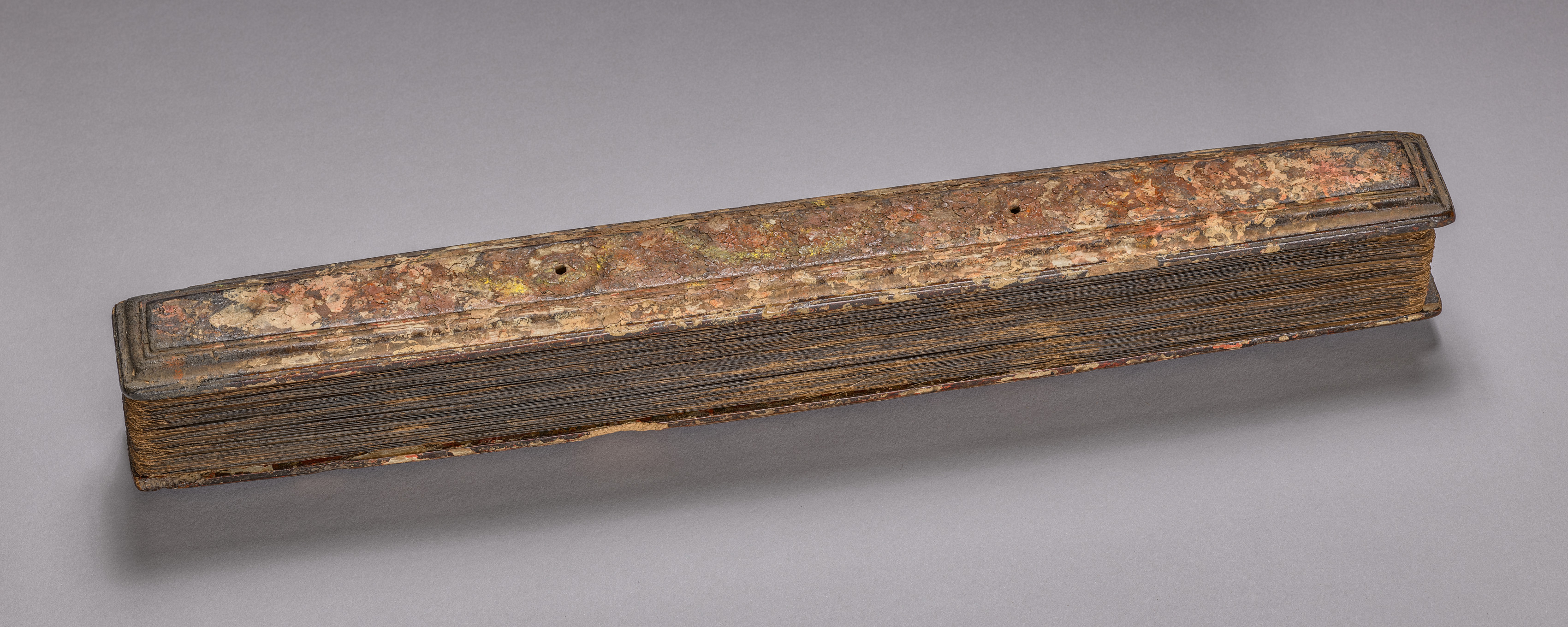
Manuscript of the Perfection of Wisdom in Eight Thousand Lines (Ashtasahasrika Prajnaparamita-sutra)
Sunday, September 14, 1119 (year 239 of the Newar Samvat in the month of Ashvina)
- Medium
- Covers: Gum tempera, colors, and paper on wood; pages: gum tempera and ink on palm leaves
- Classification
- Painting
- Dimensions
- Covers overall: 6.5 x 57 x 1.5 cm (2 9/16 x 22 7/16 x 9/16 in.)
- Culture
- Eastern India, Bihar, Vikramashila Monastery. Paintings: Nepal, Kathmandu
- Museum
- Cleveland Museum of Art, Indian and Southeast Asian Art
- Credit line
- Purchase from the J. H. Wade Fund
- Rights
- Public domain (CC0), as the museum states it.
- Who can see it
- Teens profiles and older: its museum says too little about what it shows to place it for younger viewers. How works are placed
View at the Cleveland Museum of Art
About this work
The colophon at the end of the manuscript indicates that a monk from Nepal named Aryashrimittra traveled to a monastic university in India, where he commissioned this copy of a sacred Buddhist philosophical text. He then brought it with him back to Nepal, where Nepalese artists added paintings of Buddhist goddesses and bodhisattvas. The movement of monks and manuscripts between India and Nepal was the primary mechanism for the transmission of Buddhism to the Himalayas. This manuscript was an object of worship, once venerated alongside sacred Buddhist images. Devotional materials applied during ritual worship remain on the top of the book cover.