Window mode follows your eyes with your camera, in this browser only: no picture or position leaves your device.
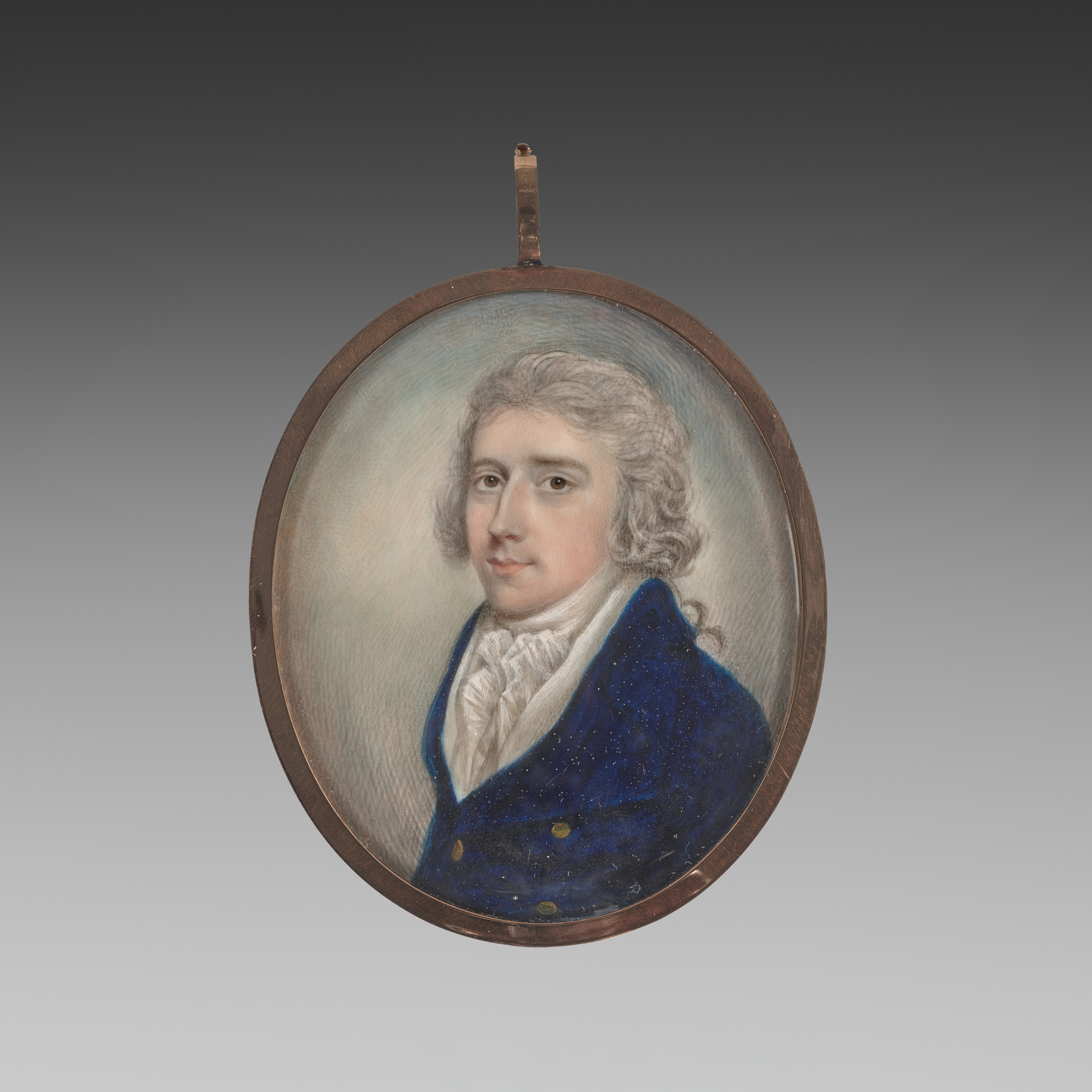
Portrait of a Man
Nicholas Freese (British, 1762–after 1824)
c. 1795–1800
- Medium
- watercolor on ivory in a gold frame with glazed hair reverse and opalescent glass over pressed foil and cut gold (or cut paper)
- Classification
- Portrait Miniature
- Dimensions
- Framed: 7.6 x 6.5 cm (3 x 2 9/16 in.); Unframed: 7 x 5.8 cm (2 3/4 x 2 5/16 in.)
- Culture
- England, late 18th century
- Museum
- Cleveland Museum of Art, European Painting and Sculpture
- Credit line
- Gift of J. H. Wade Jr., G. G. Wade and Mrs. E. B. Greene
- Rights
- Public domain (CC0), as the museum states it.
- Who can see it
- Tweens profiles and older: its subjects are known and suit older children. How works are placed
View at the Cleveland Museum of Art
About this work
Little biographical information is available about Nicholas Freese, who is often referred to as N Freese. He exhibited regularly at the Royal Academy from 1794 to 1814. Royal Academy records identify him as a “painter” rather than a “miniature painter.”
The unknown gentleman in this portrait is painted bust length in three-quarter view and facing right. He wears a blue coat with gold buttons over a white waistcoat and frilled cravat. His eyes are brown, and his powdered hair is worn en queue. There is a slightly yellow pallor to his complexion, and his nose is aquiline. The background is pale gray with a hint of green, executed with crosshatching, particularly near the edges. Freese combined watercolor with gouache, as is visible in the opaque white edges of the frilled cravat. He painted the hair using a technique in which watercolor pigment was applied then lifted away with a brush, creating channels suggesting thick, soft tendrils. The sitter’s bland, pleasant expression is not particularly individualized. His powdered hair and costume indicate that this miniature was executed around 1795–1800, when powdered hair was becoming increasingly unfashionable.