Window mode follows your eyes with your camera, in this browser only: no picture or position leaves your device.
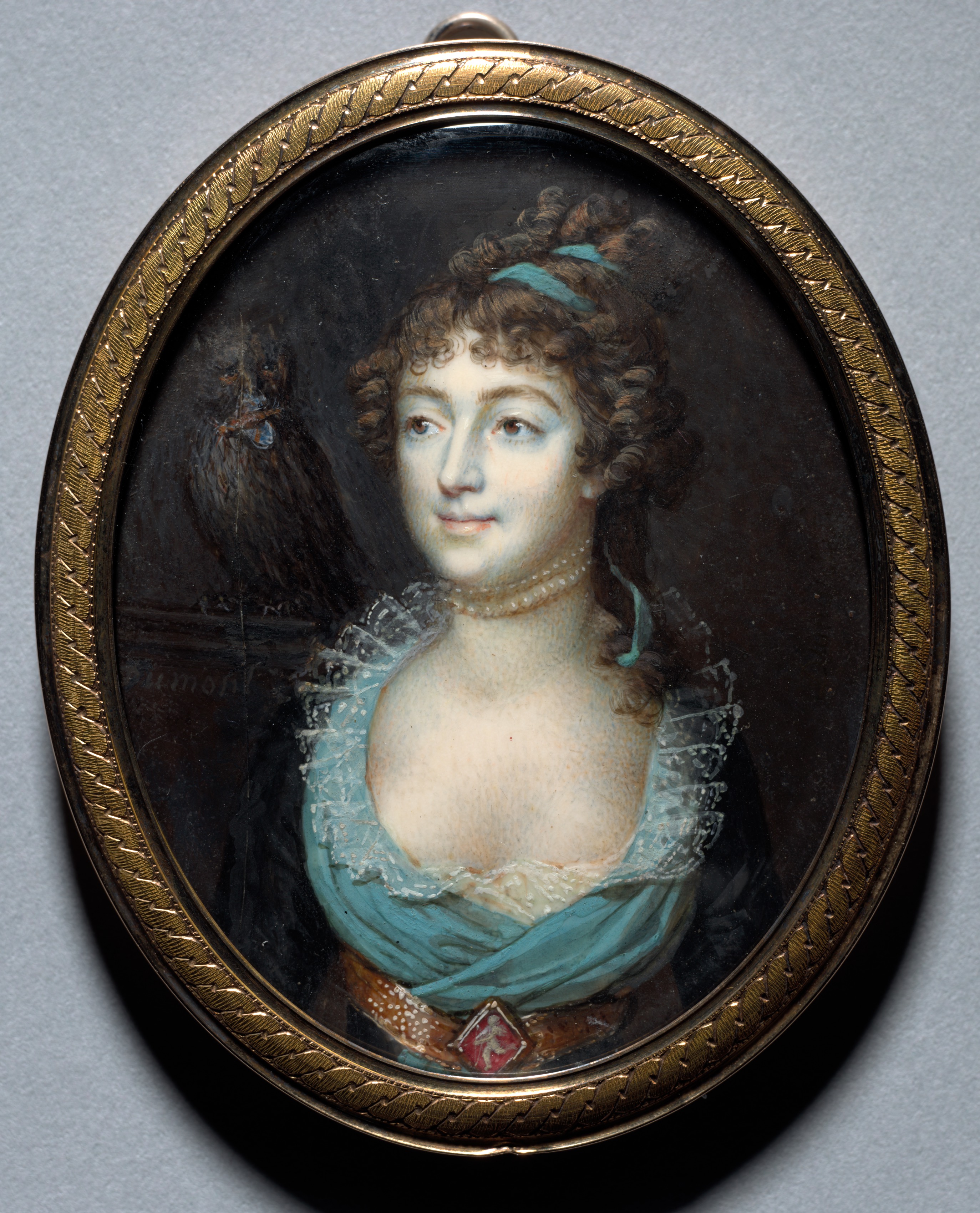
Portrait of Mademoiselle Marie-Anne Adelaide Le Normand
François Dumont (French, 1751–1831)
c. 1793
- Medium
- watercolor on ivory in a silver gilt mount
- Classification
- Portrait Miniature
- Dimensions
- Framed: 8.4 x 6.9 cm (3 5/16 x 2 11/16 in.); Unframed: 7.3 x 5.8 cm (2 7/8 x 2 5/16 in.)
- Culture
- France
- Museum
- Cleveland Museum of Art, European Painting and Sculpture
- Credit line
- Gift from J. H. Wade
- Rights
- Public domain (CC0), as the museum states it.
- Who can see it
- Adult profiles and older: its museum's description or title mentions violence, death or gore. How works are placed
View at the Cleveland Museum of Art
About this work
Mademoiselle Marie-Anne Adelaide Le Normand, a famous Parisian fortune teller, was born in Alençon, France, between 1768 and 1772. Little is known of her early years, but by 1790 she had already established a strong following in Paris. Fortune telling was a highly lucrative field perhaps due to the extreme political unrest that permeated Paris in the 1790s. Although the practice of fortune telling was illegal at the time, people from the highest social classes sought Le Normand's services. She prophesied the bloody deaths of the French revolutionaries Maximilien Robespierre, Louis Antoine de Saint-Just, and Jean-Paul Marat when they visited her salon. Additionally, Alexandre Dumas was one of many to describe Le Normand's prediction of the monumental rise and fall of both Napoleon and his wife Josephine, who visited Le Normand's studio frequently. The fortune teller managed to retain her popularity through the Napoleonic era and the reign of King Charles X before retiring from Parisian life after correctly foretelling the outcome of the July Revolution in 1830. She moved back to Alençon and continued writing books of predictions until her death in 1843. Her greatest tangible…