Window mode follows your eyes with your camera, in this browser only: no picture or position leaves your device.
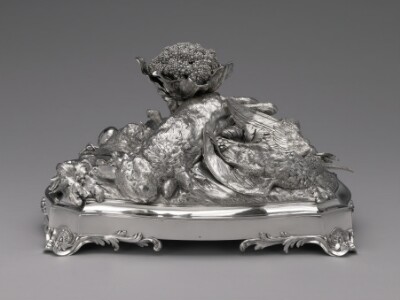
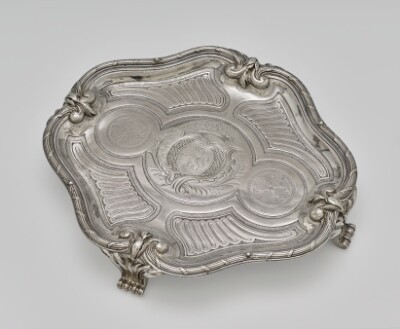
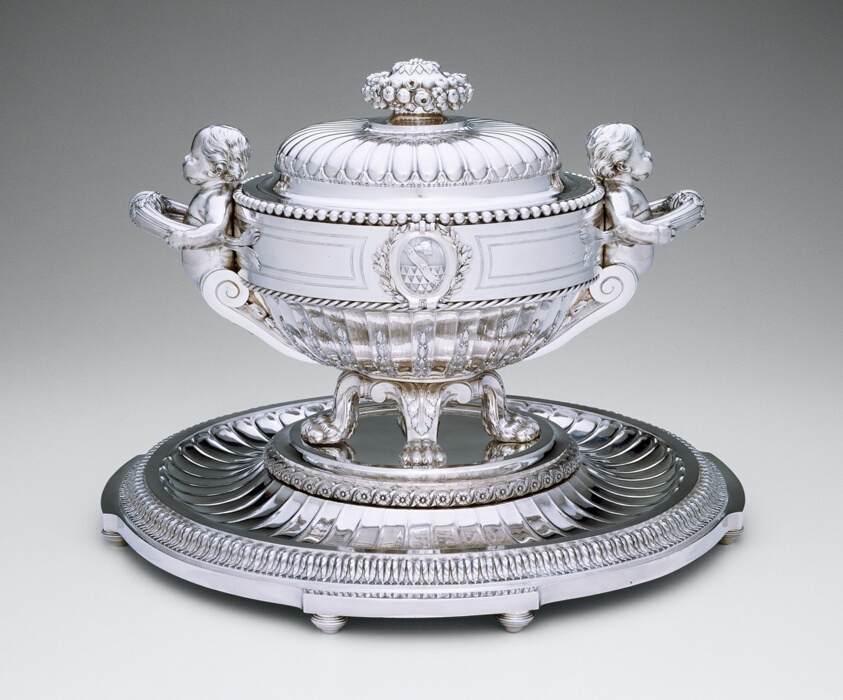
Tureen and Stand
François-Thomas Germain (French, 1721–1780; Attributed to François-Thomas Germain; French, 1726–1791)
1773/74
- Medium
- Silver
- Classification
- Metalwork
- Dimensions
- Overall: 34.3 × 48.9 cm (13 1/2 × 19 1/4 in.)
- Culture
- France
- Museum
- Art Institute of Chicago, Applied Arts of Europe
- Credit line
- Buckingham Fund
- Rights
- Public domain (CC0), as the museum states it.
- Who can see it
- Tweens profiles and older: its subjects are known and suit older children. How works are placed
View at the Art Institute of Chicago
About this work
Jean-François Dapcher, whose maker’s mark is on this early Neoclassical tureen, was a pupil of the great Parisian silversmith and goldsmith François-Thomas Germain (1726–1791). At the time the tureen was produced, Germain was on the run for bankruptcy, and forbidden by law from making or marking silver. This may have obliged him to leave his masterworks unsigned and opt for cover by his apprentice, Dapcher.
The Stroganov coat of arms, emblem of one of the grandest Russian noble families, is prominently featured on both sides of the tureen in an oval shield. The tureen was produced for Count Alexander Sergeyevitch Stroganov, Russian ambassador to London and Naples and a renowned collector and patron of the arts. Like most Russian nobles, Count Alexander loved French culture and commissioned luxurious objects from Parisian craftsmen. Only one other piece from this dinner service is known to have survived. Beef Stroganoff must have been named for a later member of the family as the recipe first appears in a cookbook only in 1861.
Description © Art Institute of Chicago, CC BY 4.0