Window mode follows your eyes with your camera, in this browser only: no picture or position leaves your device.
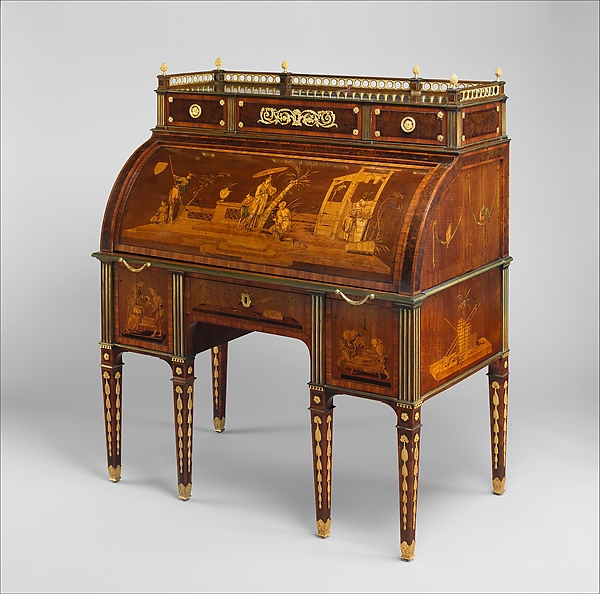
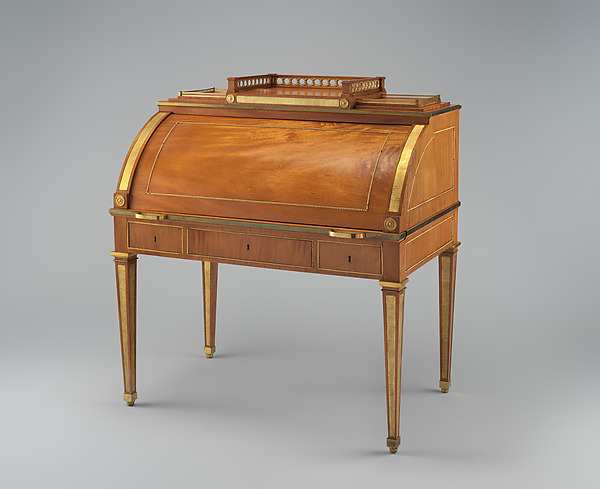
Bureau Secretary
David Roentgen (Neuwied, County of Wied-Neuwied (now Germany))
c. 1775
- Medium
- Walnut, cherry, fruitwood, pine, oak, maple, stain, gilded bronze, brass, and iron
- Classification
- Furniture
- Dimensions
- 257.9 × 152.1 × 62 cm (101 1/2 × 59 7/8 × 24 3/8 in.)
- Culture
- Neuwied
- Museum
- Art Institute of Chicago, Applied Arts of Europe
- Credit line
- Gift of Count Pecci-Blunt
- Rights
- Public domain (CC0), as the museum states it.
- Who can see it
- Teens profiles and older: its museum says too little about what it shows to place it for younger viewers. How works are placed
View at the Art Institute of Chicago
About this work
David Roentgen was a German craftsman and entrepreneur who made furniture for some of the grandest patrons in Europe, including Catherine the Great of Russia, Frederick the Great of Prussia, and Marie Antoinette of France. A brilliant artist in marquetry, Roentgen employed twenty varieties of wood in this desk, including American black walnut, which European craftsmen first began using at just this time.
The desk’s form is inspired by a design for a desk and bookcase in the English furniture maker Thomas Chippendale’s book The Gentleman and Cabinet Makers Director, published in 1754. Roentgen adapted Chippendale’s design, changing the top to a broken scrolled pediment more in keeping with the German Rococo style. The marquetry designs conjure exotic figures standing on what look like dilapidated stage sets. The depiction of these half-ruined structures became occasions for marquetry cutters to display their virtuosity. Details of birds and trees add to the charming decoration, in which the playful fantasy characteristic of chinoiserie is given free rein.
Description © Art Institute of Chicago, CC BY 4.0