Window mode follows your eyes with your camera, in this browser only: no picture or position leaves your device.
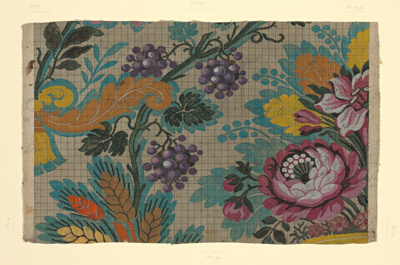
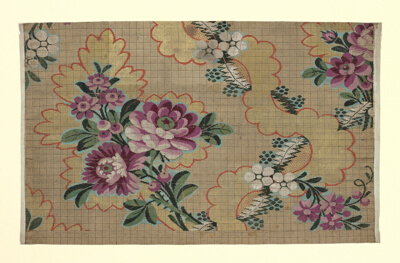
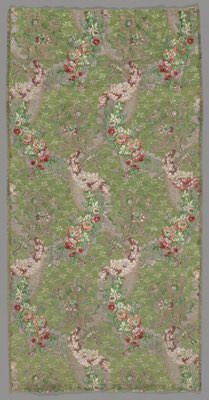
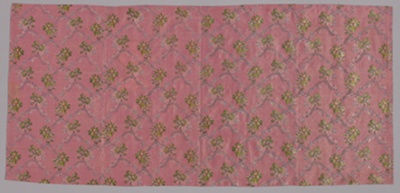
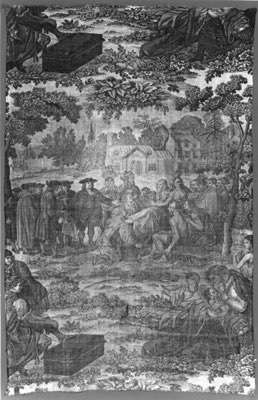
L'Exposition de 1889 (Exposition Universelle; 100th anniversary of French Revolution) (Furnishing Fabric)
c. 1890
- Medium
- Cotton, plain weave; copperplate printed
- Classification
- Textile
- Dimensions
- 184.6 × 86.3 cm (72 5/8 × 34 in.); Warp repeat: H.: 96.9 cm (38 1/8 in.)
- Culture
- France
- Museum
- Art Institute of Chicago, Textiles
- Credit line
- Purchased with funds provided by Martha Borland Willis in memory of Mrs. Chauncey B. Borland
- Rights
- Public domain (CC0), as the museum states it.
- Who can see it
- Teens profiles and older: its subject is for older viewers (war, death, the Passion, drink or the like). How works are placed
View at the Art Institute of Chicago
About this work
Augustus Welby Northmore Pugin was one of the most important early-19th-century designers of Gothic Revival architecture, furniture, and interior decoration. He trained under his French-born father, the architect Augusts Charles Pugin, an authority on medieval buildings. A devout convert to Roman Catholicism in a predominantly Anglican country, the younger Pugin proselytized through his architectural work and in a series of publications issued between 1835 and 1843. For Pugin, the Gothic style expressed the faith and conviction of the Middle Ages and was a necessary counter to the increasing secularism and industrialization of his own time. In addition to chapels and churches, he also designed the liturgical equipment, altars, hangings, and vestments within them. Pugin also adapted the Gothic Revival style for his secular commissions, which included the Houses of Parliament in London.
This chalice was designed by Pugin and produced by the workshop of Hardiman & Company, a firm retained by the architect to make metal implements and fittings for his commissions. The word MODEL is inscribed on its underside, which suggests that the vessel served as a sample to be shown to potential…
Description © Art Institute of Chicago, CC BY 4.0