Window mode follows your eyes with your camera, in this browser only: no picture or position leaves your device.
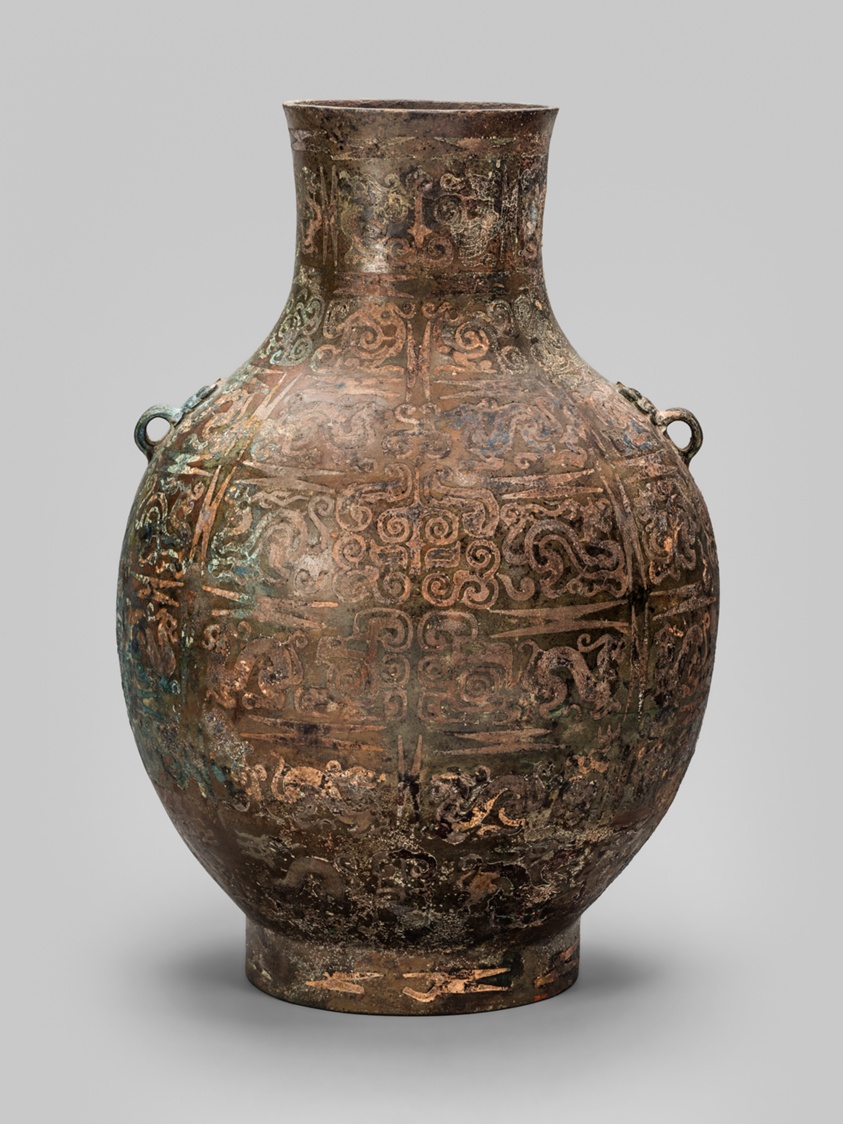
Jar (hu)
Eastern Zhou dynasty, Warring States period (475–221 B.C.)
- Medium
- Bronze inlaid with copper
- Classification
- Metalwork
- Dimensions
- 44.7 × 30.6 cm (17 5/8 × 12 in.); Diam.: 30.5 cm (12 in.)
- Culture
- China
- Museum
- Art Institute of Chicago, Arts of Asia
- Credit line
- Lucy Maud Buckingham Collection
- Rights
- Public domain (CC0), as the museum states it.
- Who can see it
- Teens profiles and older: its museum says too little about what it shows to place it for younger viewers. How works are placed
View at the Art Institute of Chicago
About this work
The introduction of metallic inlay enriched bronze vessels with color. In this jar, curvilinear silhouettes of birds, feline creatures, and stags were cast from flat sheets of copper and arranged in pairs in the clay mold assembly. Telltale signs of this technique appear around the foot rim, where some of these copper inlays broke and were displaced when molten bronze was poured into the assembly.
These inlaid images, which were probably inspired by contemporary designs in lacquer painting and embroidery, provide some of the earliest evidence of pictorial representation in Chinese art. In this vessel, such images are stylized to form S-curves, and are more decorative than realistic. The monster mask, a prominent design on earlier bronze vessels, is also abstracted; its horns, nose, and jaws are converted into spirals. Four masklike configurations are centered on the bulge of this vessel; two appear beneath three-dimensional monster masks, which originally held rings.
Description © Art Institute of Chicago, CC BY 4.0