Window mode follows your eyes with your camera, in this browser only: no picture or position leaves your device.
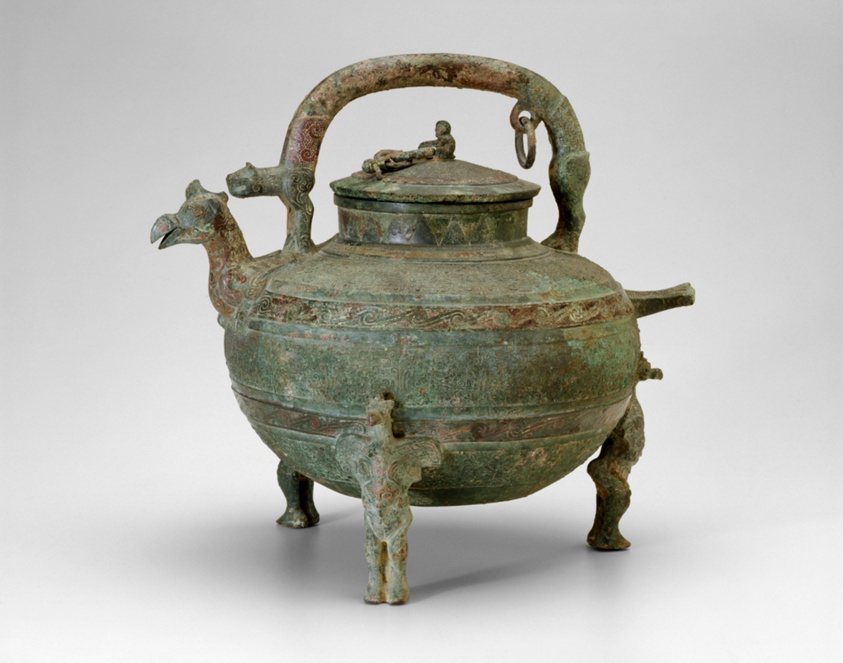
Water Ewer (He)
Eastern Zhou dynasty, Warring States period (480–221 B.C.), 4th century B.C.
- Medium
- Bronze with copper inlay
- Classification
- Metalwork
- Dimensions
- 25.4 × 21 cm (10 1/8 × 8 1/4 in.); Diam.: 21 cm (8 1/4 in.)
- Culture
- China
- Museum
- Art Institute of Chicago, Arts of Asia
- Credit line
- Lucy Maud Buckingham Collection
- Rights
- Public domain (CC0), as the museum states it.
- Who can see it
- Teens profiles and older: its museum says too little about what it shows to place it for younger viewers. How works are placed
View at the Art Institute of Chicago
About this work
Whereas this type of water ewer is found together with wine vessels in tombs of the Shang period, it typically appears with a shallow water basin (pan) in Zhou tombs. This change in burial context suggests a change in function—from a vessel used to dilute wine to one used to pour ablutions. In this imaginative, finely cast example, various creatures assume different parts: bird-men (or men with birdlike headdresses) form the legs; a bird's head acts as the spout; and on the lid, a small monkey grasps a chain linked to a feline animal whose broadly arched back forms the handle.
Description © Art Institute of Chicago, CC BY 4.0