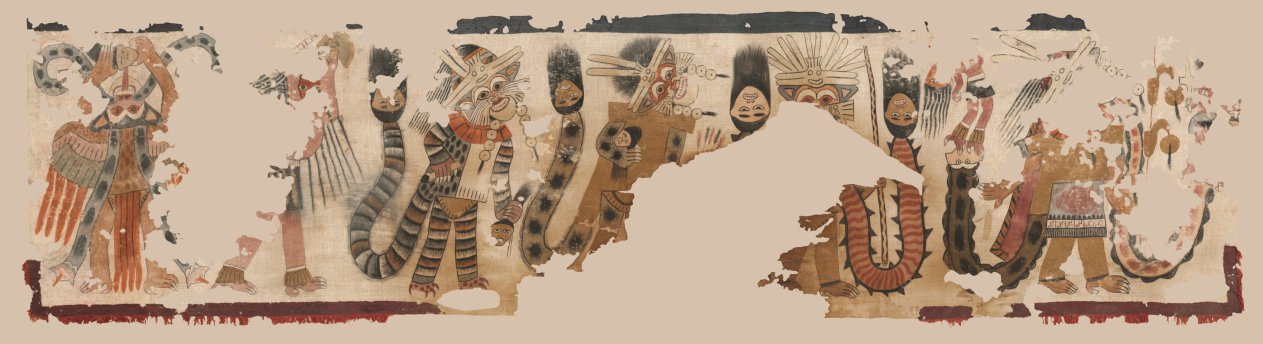
Funerary Bundle Mask
Paracas (Probably Ocucaje, Ica Valley, south coast, Peru)
2nd century BCE
- Medium
- Cotton, plain weave with bundles of extended warps; painted
- Classification
- Textile
- Dimensions
- Without extended warps: 20.8 × 20.7 cm (8 3/16 × 8 1/8 in.)
- Culture
- Peru
- Museum
- Art Institute of Chicago, Textiles
- Credit line
- Simeon B. Williams Fund
- Rights
- Public domain (CC0), as the museum states it.
- Who can see it
- Teens profiles and older: its museum says too little about what it shows to place it for younger viewers. How works are placed
View at the Art Institute of Chicago
About this work
Ancient South American communities maintained elaborate funerary traditions that included preserving and dressing the dead. Among the Paracas from the south coast of what is now Peru, deceased individuals were placed in a seated position and wrapped in layers of textiles and offerings, forming rounded bundles about three to four feet high. These bundles were often dressed in garments, headdresses, and masks, suggesting that the deceased’s identity continued after death.
Masks with lengths of unwoven warp loops—either folded behind the mask or tied into a circular topknot—were padded with unspun cotton and sewn atop a funerary bundles to emulate a human head and hair. They were often painted with stylized faces.
Description © Art Institute of Chicago, CC BY 4.0