Window mode follows your eyes with your camera, in this browser only: no picture or position leaves your device.
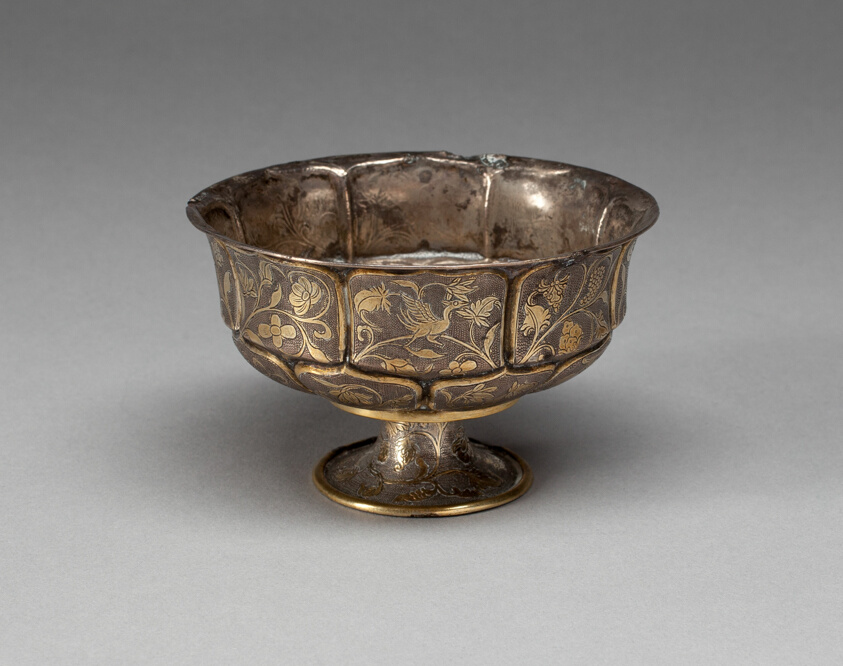
Stem Cup
Tang dynasty (618–907), 9th century
- Medium
- Silver with parcel gilt decoration
- Classification
- Vessel
- Dimensions
- 4.8 × 7.8 cm (3 1/8 × 1 15/16 in.); Diam.: 4.9 cm (1 15/16 in.)
- Culture
- China
- Museum
- Art Institute of Chicago, Arts of Asia
- Credit line
- Gift of Mr. Russell Tyson
- Rights
- Public domain (CC0), as the museum states it.
- Who can see it
- Tweens profiles and older: its subjects are known and suit older children. How works are placed
View at the Art Institute of Chicago
About this work
The form of this wine cup was inspired by goblets made in the Sasanian and Sogdian empires, but originally derived from Hellenistic styles of the Mediterranean world. Its low, spreading foot gently flares into faceted petals suggesting a lotus flower. Since the introduction of Buddhism to China, the lotus—which emerges unstained from muddy water and therefore carries associations of purity and non-attachment to worldly concerns—had become a pervasive motif in secular as well as religious art. Two layers of petals, beaten in repousse, enclose birds, floral sprays, and clusters of grapes—all delicately chased and gilded against a ringmatted ground. This mixture of native and imported decorative motifs, which followed the seventh-century introduction of grapevines and grape wine from Iranian and Turkic lands, is executed with a linear fluency that is distinctively Chinese.
Description © Art Institute of Chicago, CC BY 4.0