Window mode follows your eyes with your camera, in this browser only: no picture or position leaves your device.
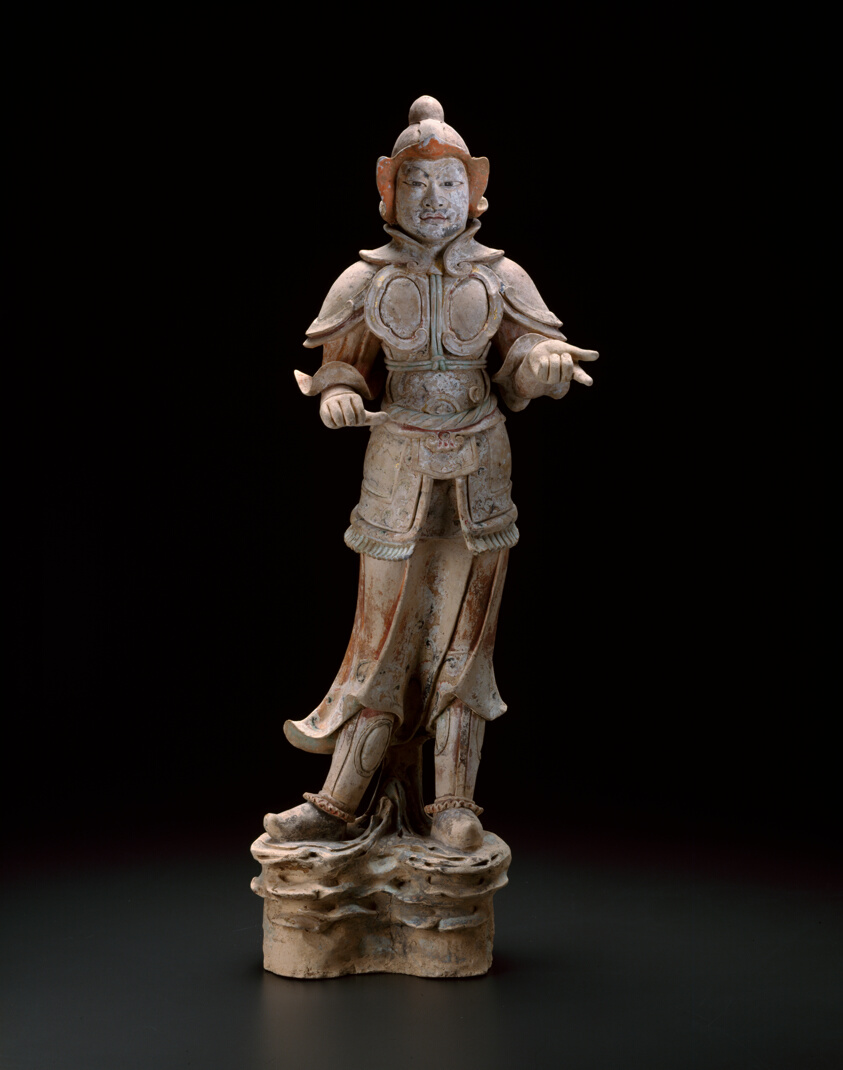
Armored Guardian
Tang dynasty (618–907), late 7th or early 8th century
- Medium
- Buff earthenware with polychrome and gilding
- Classification
- Sculpture
- Dimensions
- H.: 96.5 cm (38 in.)
- Culture
- China
- Museum
- Art Institute of Chicago, Arts of Asia
- Credit line
- Gift of Russell Tyson
- Rights
- Public domain (CC0), as the museum states it.
- Who can see it
- Teens profiles and older: its museum says too little about what it shows to place it for younger viewers. How works are placed
View at the Art Institute of Chicago
About this work
Ceramic figures made for burial in the tombs of princes and officials vividly evoke aspects of the elite life of China's expansive and multicultural Tang dynasty (618-907). This armored guardian of haughty, impenetrable expression stands on a rocky plinth and was probably stationed close to the burial chamber to repel potential evil. One hand turns down in a clenched fist and the other turns upward with an outstretched finger, suggesting that both hands once brandished a weapon, now lost. His multilayered parade armor combines a helmet with upturned earflaps; neck and shoulder guards; scalloped breast and backplates secured by knotted ropes over a tunic with pleated hem; flared elbow cuffs over long, tight sleeves; and protective leggings under a sweeping skirt. The elements of this elaborate uniform were meticulously modeled in clay before firing and richly embellished with colors and gold pigment afterward.
Because these so-called "cold pigments" are more vulnerable to deterioration than fired glazes, only traces of the most detailed patterns survive. These combine curled tendrils and scalloped floral scrolls on the armor, giving elegantly decorative flourishes to the armor of…
Description © Art Institute of Chicago, CC BY 4.0