Window mode follows your eyes with your camera, in this browser only: no picture or position leaves your device.
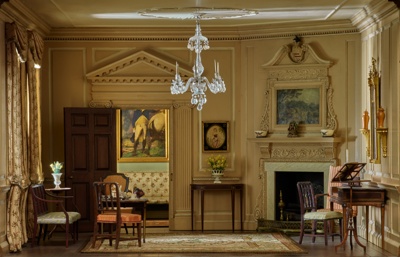
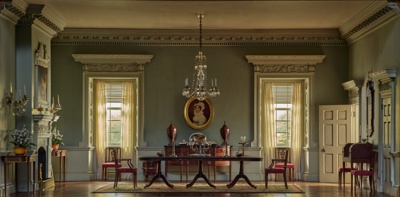
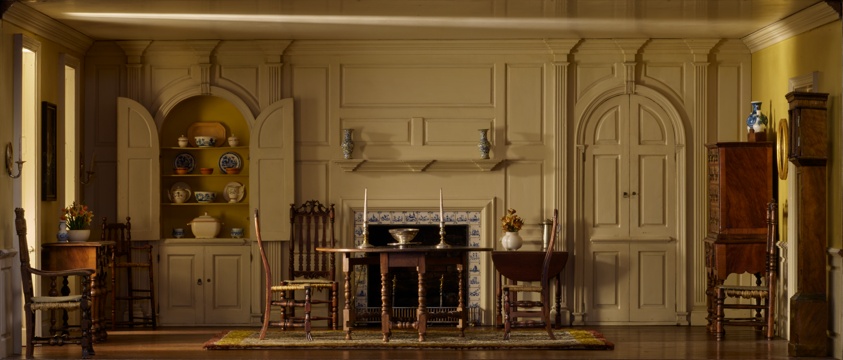
A3: Massachusetts Dining Room, 1720
Narcissa Niblack Thorne (American, 1882–1966)
c. 1940
- Medium
- Miniature room, mixed media
- Classification
- Miniature room
- Dimensions
- External : 52.8 × 118.5 × 54.7 cm (20 3/4 × 46 5/8 × 21 1/2 in.); Internal (main room only): 22.9 × 53.4 × 50.2 cm (9 × 21 × 19 3/4 in.)
- Culture
- United States
- Museum
- Art Institute of Chicago, Applied Arts of Europe
- Credit line
- Gift of Mrs. James Ward Thorne
- Rights
- Public domain (CC0), as the museum states it.
- Who can see it
- Tweens profiles and older: its subjects are known and suit older children. How works are placed
View at the Art Institute of Chicago
About this work
Narcissa Niblack Thorne, creator of the Thorne Rooms, combined a deep knowledge of design history with a vivid imaginative sensibility. In the 1930s, she assembled a team of skilled artisans in Chicago to construct a series of intricately detailed interiors at the scale of one inch to one foot (1:12).
Conceived as a visual history of interior design, the rooms are at once scholarly and inventive. Meticulously researched and carefully composed, they balance historical accuracy with artistic interpretation. Each atmospheric interior feels like a stage set awaiting its occupants—two parts fantasy, one part history, and entirely absorbing.
Entry from Fannia Weingartner, Miniature Rooms: The Thorne Rooms at the Art Institute of Chicago, 2nd ed. (The Art Institute of Chicago, 2004):
3: Massachusetts Dining Room, 1720 More sophisticated than the preceding interior in terms of its architecture and furnishings, this early-eighteenth-century dining room was based on a 1720s addition to the historic Turner-Ingersoll residence built in Salem in 1668. Nathaniel Hawthorne used this house as the setting for his novel The House of the Seven Gables, published in 1851. A fishing town, Salem…
Description © Art Institute of Chicago, CC BY 4.0