Window mode follows your eyes with your camera, in this browser only: no picture or position leaves your device.
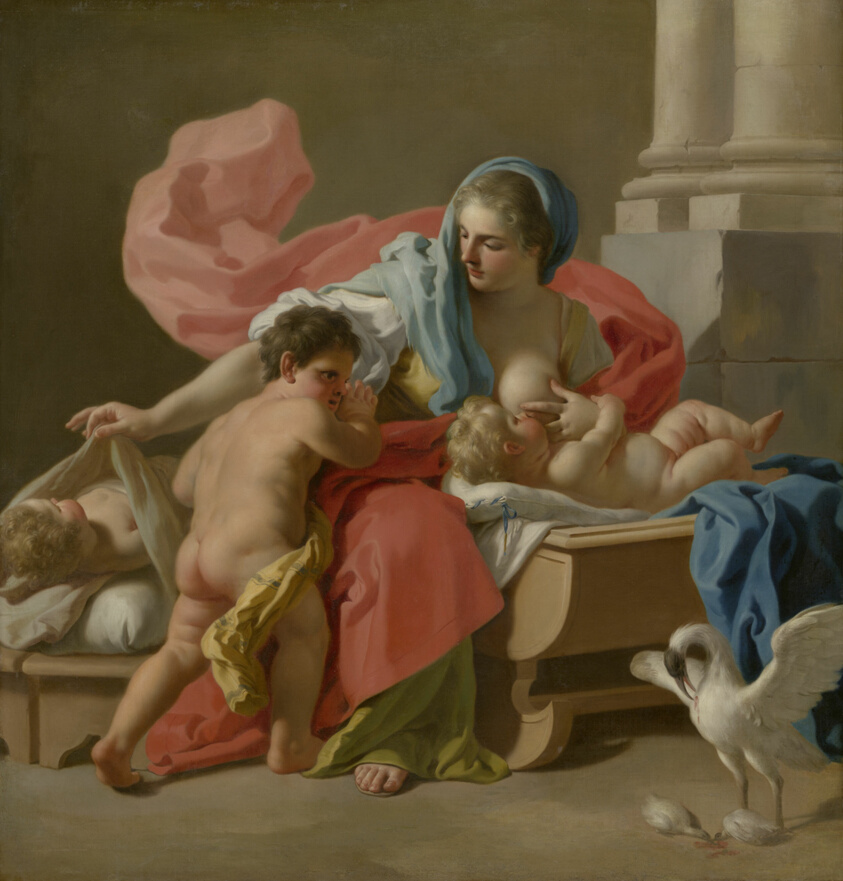
Allegory of Charity
Francesco de Mura (Italian, 1696-1782)
c. 1743–44
- Medium
- Oil on canvas
- Classification
- Painting
- Dimensions
- 139.5 × 134.6 cm (54 15/16 × 53 in.); Framed: 159.4 × 159.4 cm (62 3/4 × 62 3/4 in.)
- Culture
- Italy
- Museum
- Art Institute of Chicago, Painting and Sculpture of Europe
- Credit line
- Preston O. Morton Memorial Fund for Older Paintings
- Rights
- Public domain (CC0), as the museum states it.
- Who can see it
- Adult profiles and older: its museum's description or title mentions violence, death or gore. How works are placed
View at the Art Institute of Chicago
About this work
This painting presents an allegory of the virtue of charity through images of maternal love and sacrifice: a mother nurtures several young children and a pelican feeds her young by drawing blood from her own breast. This work was one of a set of allegories of five virtues intended as decorations set above doors in a palace belonging to the king of Savoy, a region in northwest Italy. Francesco de Mura spent most of his career in Naples but also worked for the king of Savoy in the 1740s, producing paintings in a style that combined grand, calm figures with active drapery. Although it is now rectangular, the canvas shows signs of an earlier curved shape appropriate to a Rococo room decoration.
Description © Art Institute of Chicago, CC BY 4.0