Window mode follows your eyes with your camera, in this browser only: no picture or position leaves your device.
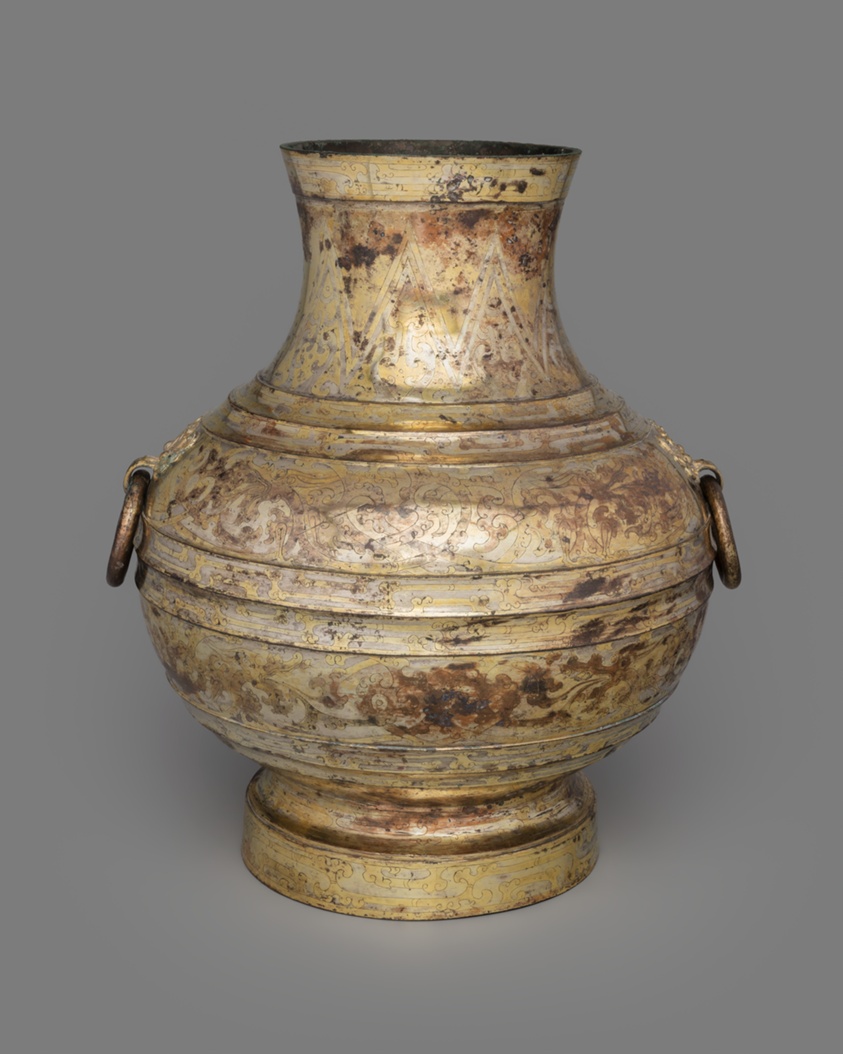
Jar (hu or zhong)
Western Han dynasty (206 B.C.–A.D.9)
- Medium
- Bronze with gilding
- Classification
- Metalwork
- Dimensions
- 46 × 36 cm (18 1/8 × 14 13/16 in.); Diam.: 37.7 cm (14 13/16 in.)
- Culture
- China
- Museum
- Art Institute of Chicago, Arts of Asia
- Credit line
- Lucy Maud Buckingham Collection
- Rights
- Public domain (CC0), as the museum states it.
- Who can see it
- Tweens profiles and older: its subjects are known and suit older children. How works are placed
View at the Art Institute of Chicago
About this work
The dragon became prominent during the Han as an auspicious creature associated with imperial authority and with the ever-changing nature of the universe. Since the dragon was endowed with the same dynamic energy that animated clouds and vapors, it was graphically combined with expanding and contracting patterns of great imagination and vitality. Here, dragons with interlaced trunks merge with scrolling "cloud" patterns to create continuous bands of ornament. This fluent decor was incised into the bronze after casting. Filings of gold and silver were then liquefied in separate baths of hot mercury and these butter-like solutions brushed onto the bronze; the vessel was reheated to vaporize the mercury and then burnished, leaving a thin but brilliant two-toned surface. This technique, variously known as amalgam-, mercury-, or fire-gilding, created a splendid object with economic expenditure of precious metals.
Description © Art Institute of Chicago, CC BY 4.0