Window mode follows your eyes with your camera, in this browser only: no picture or position leaves your device.
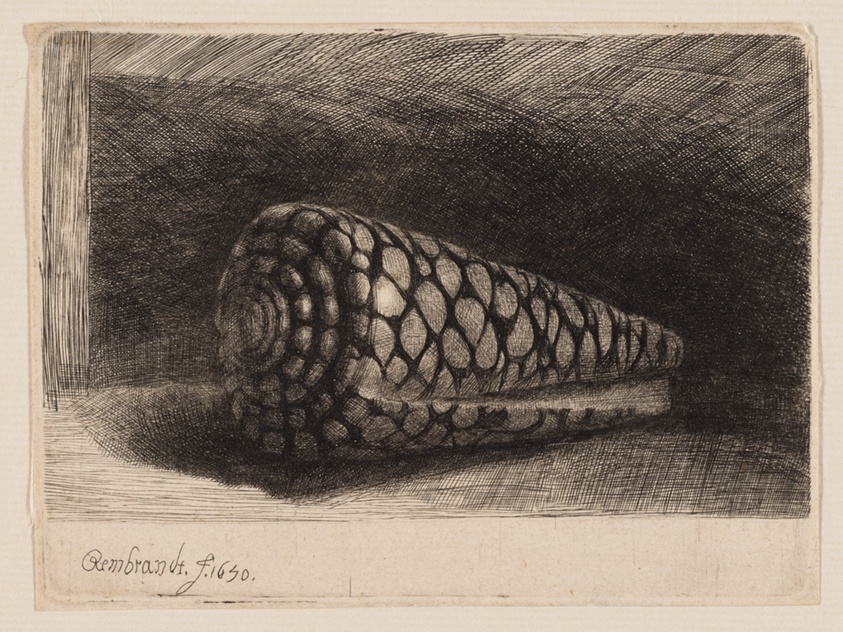
The Shell
Rembrandt van Rijn (Dutch, 1606-1669)
1650
- Medium
- Etching on ivory laid paper
- Classification
- Dimensions
- Plate: 9.7 × 13.2 cm (3 7/8 × 5 1/4 in.); Sheet: 9.9 × 13.4 cm (3 15/16 × 5 5/16 in.)
- Culture
- Holland
- Museum
- Art Institute of Chicago, Prints and Drawings
- Credit line
- Clarence Buckingham Collection
- Rights
- Public domain (CC0), as the museum states it.
- Who can see it
- Little Ones profiles and older: it shows gentle subjects for the very young. How works are placed
View at the Art Institute of Chicago
About this work
In the 17th century, seashells became popular collectible objects because they were considered rare and exotic. They also became common subjects for still-life paintings known as Vanitas, which symbolically represent the transience of life. The etchings of both Wenceslaus Hollar and Rembrandt van Rijn could represent the simultaneous beauty and fragility of existence. While still lifes in general are exceedingly rare in Rembrandt’s work, Hollar’s etching (1996.609) comes from a series of seashells, consisting of 38 plates. Rembrandt’s shell could have been inspired by Hollar’s work, though Rembrandt’s decision to render the shell in a three-dimensional space represents a marked difference between the two etchings.
Description © Art Institute of Chicago, CC BY 4.0