Window mode follows your eyes with your camera, in this browser only: no picture or position leaves your device.
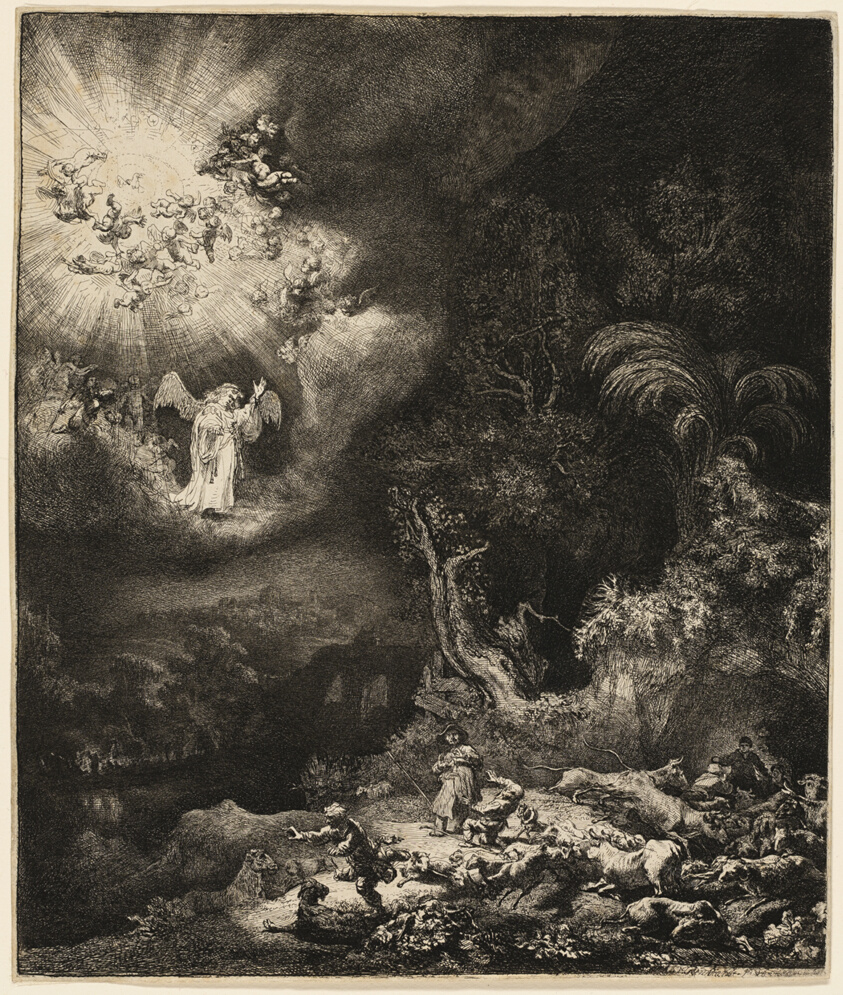
The Angel Appearing to the Shepherds
Rembrandt van Rijn (Dutch, 1606-1669)
1634
- Medium
- Etching, engraving, and drypoint in black on ivory laid paper
- Classification
- Dimensions
- Image/plate: 25.9 × 21.8 cm (10 1/4 × 8 5/8 in.); Sheet: 26.2 × 22 cm (10 3/8 × 8 11/16 in.)
- Culture
- Holland
- Museum
- Art Institute of Chicago, Prints and Drawings
- Credit line
- Clarence Buckingham Collection
- Rights
- Public domain (CC0), as the museum states it.
- Who can see it
- Tweens profiles and older: its subjects are known and suit older children. How works are placed
View at the Art Institute of Chicago
About this work
This nocturnal scene from the Gospel of Luke represents Rembrandt’s first attempt to render shadows in print with the same gravity and depth he achieved in oil paint. In the upper left, an angel stands before a glowing celestial vortex and announces the birth of Christ. At the center of the divine light is the dove of the Holy Spirit, defined by a few small marks. Terrified by the sudden blast in the night, herdsman and their beasts run amok. To depict the stunning collision between heaven and earth, Rembrandt first scratched a detailed compositional outline with a sharp needle and etched lines. He then built a range of grays and deep blacks by crisscrossing layers of lines in varying widths. This fine netting of shadow echoes the spontaneity of the moment and differs from the rigidity and systematized decorative patterns seen in the work of predecessors such as Hendrik Goudt.
Description © Art Institute of Chicago, CC BY 4.0