Window mode follows your eyes with your camera, in this browser only: no picture or position leaves your device.
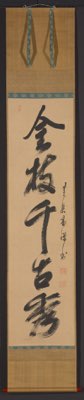
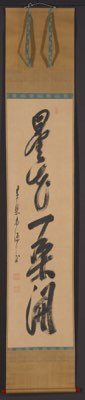
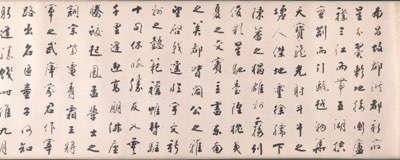
Triptych of Calligraphy
Katsuzan Dowa (Chinese, 1634–1707)
Late 17th–early 18th century
- Medium
- Set of three hanging scrolls; ink on paper
- Classification
- Painting
- Dimensions
- 140.9 × 37.5 cm (55 1/2 × 14 3/4 in.)
- Culture
- Japan
- Museum
- Art Institute of Chicago, Arts of Asia
- Credit line
- Restricted Gift of Muriel Kallis Newman
- Rights
- Public domain (CC0), as the museum states it.
- Who can see it
- Tweens profiles and older: its subjects are known and suit older children. How works are placed
View at the Art Institute of Chicago
About this work
In the 17th and 18th centuries, the Ōbaku sect of Zen Buddhism flourished in Japan, bringing Chinese monks such as this artist, Katsuzen Dōwa, and other emigrants to Nagasaki. The city’s inhabitants were eager to learn about the Chinese arts of literature, painting, and especially calligraphy, which was particularly prized for its ability to express a man’s inner character.
This set of hanging scrolls by Dōwa reflects the influence of Zen philosophy on Japanese art. Each scroll presents a separate Buddhist saying, but together they speak to the power and preciousness of life. From right to left, the lines of poetry read:
The Golden Deva—thrives a thousand years! The Udumbara tree—just one leaf blooms! The Jade Leaf—burgeons for ten thousand years!
Description © Art Institute of Chicago, CC BY 4.0