Window mode follows your eyes with your camera, in this browser only: no picture or position leaves your device.
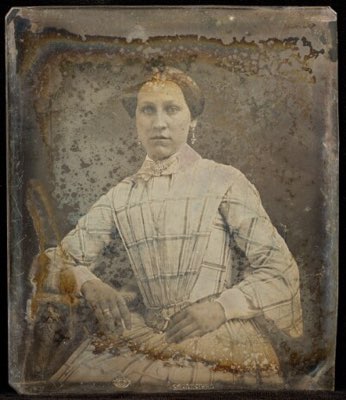
Fireman
Unknown artist (American, 19th century)
1850/60
- Medium
- Daguerreotype
- Classification
- Photograph
- Dimensions
- Plate, sight: 8.8 × 6.7 cm (3 1/2 × 2 11/16 in.); Case: 12 × 9.4 × 1 cm (4 3/4 × 3 3/4 × 7/16 in.)
- Culture
- United States
- Museum
- Art Institute of Chicago, Photography and Media
- Credit line
- Purchased with funds provided by Eric Ceputis and David Williams in honor of Liz Siegel
- Rights
- Public domain (CC0), as the museum states it.
- Who can see it
- Tweens profiles and older: its subjects are known and suit older children. How works are placed
View at the Art Institute of Chicago
About this work
Inexpensive and astonishingly sharp, daguerreotypes were the most popular portrait form of the 1840s and 1850s. One subset of American daguerreotypes, so-called occupationals, showed workers posing with tools of their trade. These images celebrated American craft and labor, their subjects personifying traits like innovation, industriousness, and courage. This daguerreotype reveals that its sitter understood, and accommodated, the daguerreotype process, which reverses the image. To have his unit number read (almost) correctly, the fireman obligingly posed with his belt upside-down, sacrificing the N to get the O and E in the right place. Even in photography’s infancy, people knew how to pose for the camera; from this moment on, self-presentation would be mediated through its lens.
Description © Art Institute of Chicago, CC BY 4.0