Window mode follows your eyes with your camera, in this browser only: no picture or position leaves your device.
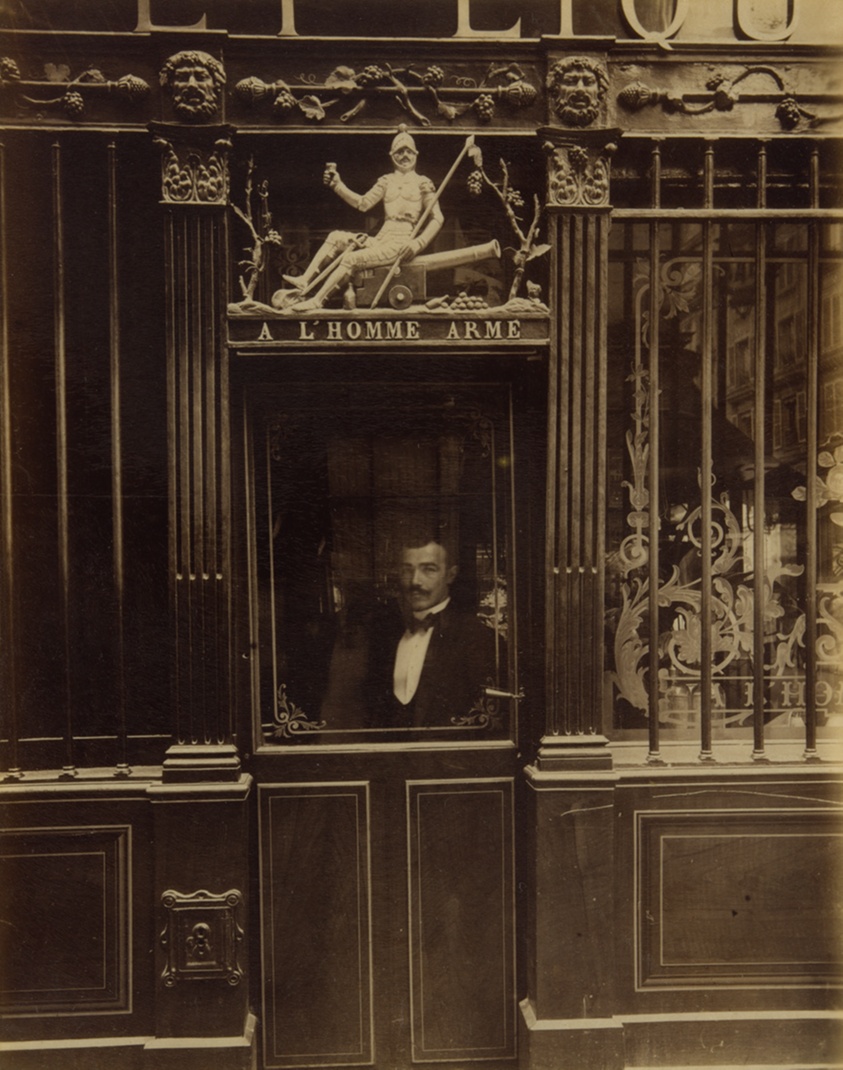
Cabaret de l'Homme Armé, Rue des Blancs-Manteaux
Jean-Eugène-Auguste Atget (French, 1857–1927)
1900
- Medium
- Albumen print
- Classification
- Photograph
- Dimensions
- Image/paper: 22.1 × 17.4 cm (8 3/4 × 6 7/8 in.)
- Culture
- France
- Museum
- Art Institute of Chicago, Photography and Media
- Credit line
- Purchased with funds provided by Anstiss and Ronald Krueck in honor of Matthew S. Witkovsky
- Rights
- Public domain (CC0), as the museum states it.
- Who can see it
- Teens profiles and older: its subject is for older viewers (war, death, the Passion, drink or the like). How works are placed
View at the Art Institute of Chicago
About this work
Eugène Atget systematically photographed traditional establishments and vernacular settings in Paris—fundamental aspects of the city under threat from new construction and industrialization. Successful before World War I as a purveyor of “Old Paris” to libraries and artists, in his final years (and posthumously) he became a cult favorite of two specific and influential sets—European Surrealists and American documentarians. Atget included this early image of a cabaret in a 1913 album of 60 images called Signs and Old Shops in Paris. He focused here equally on the emblem of “the armed man”—a title (and a tavern) dating to the medieval crusades, rendered in word and image to assure its familiarity to a partially illiterate clientele—and on the maitre d’, who gazes back through a glass window that also reflects, like a ghost, the likeness of the photographer himself.
Description © Art Institute of Chicago, CC BY 4.0