Window mode follows your eyes with your camera, in this browser only: no picture or position leaves your device.
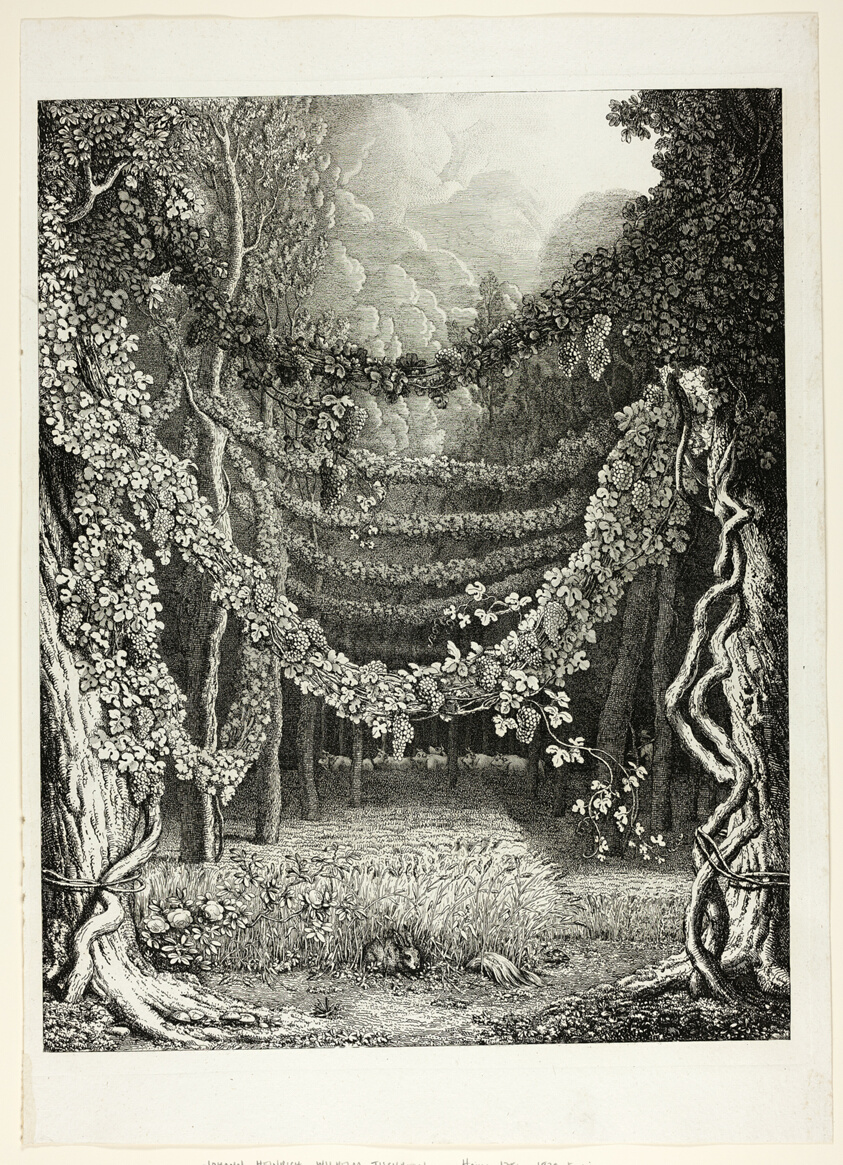
Oenotria Telus, An Idealized Woodland Scene Near Naples
Johann Heinrich Tischbein, II (German, 1751-1829)
1796
- Medium
- Etching in black on ivory wove paper
- Classification
- Dimensions
- Image: 43.4 × 34 cm (17 1/8 × 13 7/16 in.); Plate, approx.; trimmed within left plate edge: 45.2 × 35.6 cm (17 13/16 × 14 1/16 in.); Sheet: 51.4 × 36.7 cm (20 1/4 × 14 1/2 in.)
- Culture
- Germany
- Museum
- Art Institute of Chicago, Prints and Drawings
- Credit line
- Purchased with funds provided by Dorothy Braude Edinburg to the Harry B. and Bessie K. Braude Memorial Collection
- Rights
- Public domain (CC0), as the museum states it.
- Who can see it
- Little Ones profiles and older: it shows gentle subjects for the very young. How works are placed
View at the Art Institute of Chicago
About this work
This sizable landscape print by Tischbein, the German director of the Neapolitan art academy, served as a frontispiece for his book Homer Drawn after the Antique. Tischbein also describes himself on the title page as the depot director of the Farnese Antiquities, a Renaissance-era collection, which he moved from Rome to Naples. Rather than reproducing Homeric scenes from ancient sculpture as was done elsewhere in the book, this etching depicts the verdant landscape of the Cyclops Polyphemus’s island before the advent of the dangerous Odysseus, imagining it as a secluded glade in Naples. The luscious hanging swags of grapes bar the viewer’s entry while dangling the promise of wine to Dionysos’s devotees.
Description © Art Institute of Chicago, CC BY 4.0