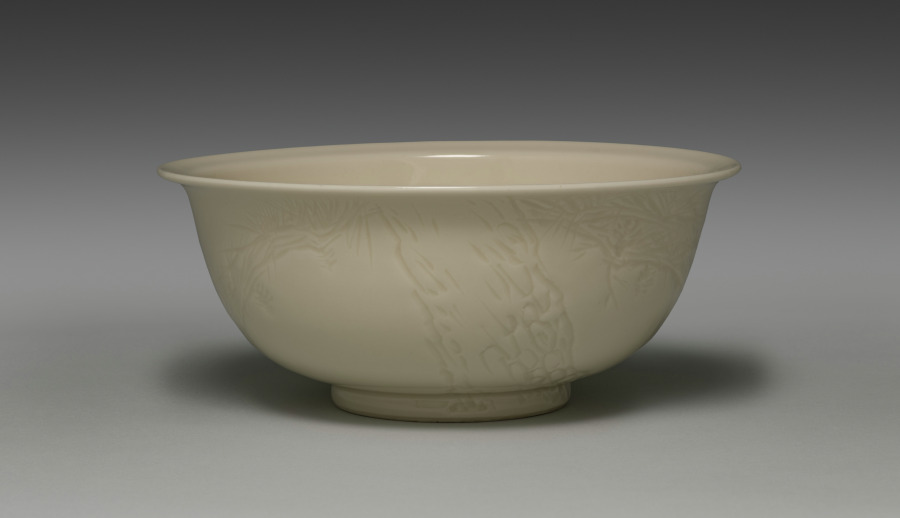
Bowl with Calligraphic Design
Samanid dynasty (819-1005), 10th century
- Medium
- Earthenware, white slip with black slip decoration under a transparent glaze
- Classification
- Ceramics
- Dimensions
- 9 × 26.1 cm (3 3/8 × 10 1/4 in.); Diam.: 26.1 cm (10 1/4 in.)
- Culture
- Iran
- Museum
- Art Institute of Chicago, Arts of Asia
- Credit line
- Gift of Harvey and Beth Plotnick
- Rights
- Public domain (CC0), as the museum states it.
- Who can see it
- Tweens profiles and older: its subjects are known and suit older children. How works are placed
View at the Art Institute of Chicago
About this work
In the 10th and 11th centuries, a tradition of painting ceramics in thick colored slips (watered-down clay) became common practice in central and eastern Iran. These vessels were typically decorated with simple calligraphic lines, often containing blessings or pious insights, not unlike fortune cookie messages. Here the text reads, "[Generosity] is a disposition of the dwellers of Paradise... regret." This type of script is known as knotted Kufic, distinctive for its consistent baseline and embellished by small knots and twists in the staffs of the letters.
Description © Art Institute of Chicago, CC BY 4.0