Window mode follows your eyes with your camera, in this browser only: no picture or position leaves your device.
Fireboard
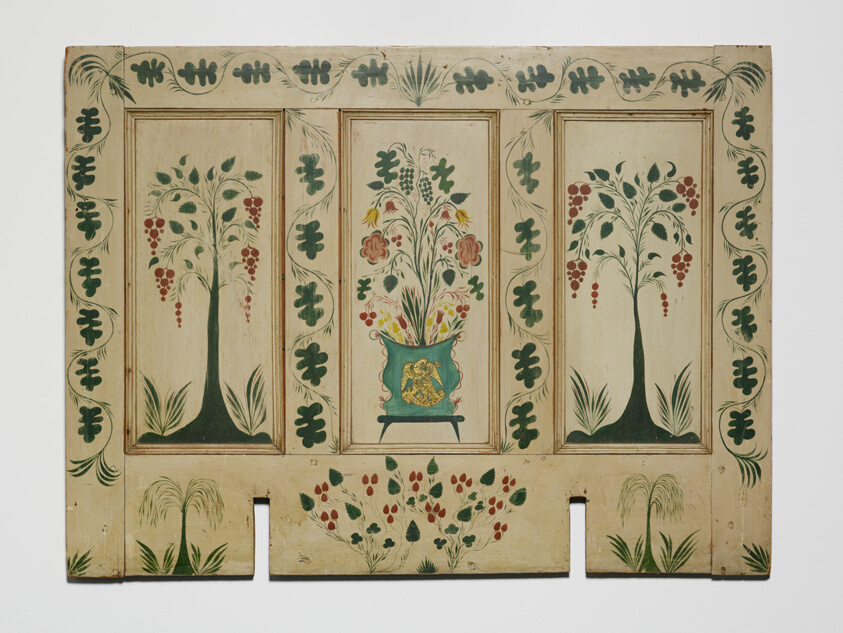
Possibly "Stimp" (active c. 1820) (From the John Moseley House, Southbury, Connecticut)
c. 1820
- Medium
- Oil on pine panel
- Classification
- Architectural fragment
- Dimensions
- 87.6 × 116.2 cm (34 1/4 × 45 3/4 in.)
- Culture
- Southbury
- Museum
- Art Institute of Chicago, Arts of the Americas
- Credit line
- Purchased with funds provided by the Antiquarian Society; Quinn E. Delaney Fund; purchased with funds provided by Mrs. Herbert A. Vance, Charles C. Haffner III, and Jan Pavlovic
- Rights
- Public domain (CC0), as the museum states it.
- Who can see it
- Little Ones profiles and older: it shows gentle subjects for the very young. How works are placed
View at the Art Institute of Chicago
About this work
The fireplace and hearth served as the center of eighteenth- and early-nineteenth-century American homes. In larger houses that had fireplaces in more than one room, they were often "dressed up" with paintings hung above the mantel and fireboards. The latter were especially common during the summer months, when they were utilized to beautify the gaping hole of the unused fireplace. This fireboard was painted right around 1820, when John Moseley completed the construction of a house on Main Street North in Southbury, Connecticut.
Description © Art Institute of Chicago, CC BY 4.0