Window mode follows your eyes with your camera, in this browser only: no picture or position leaves your device.
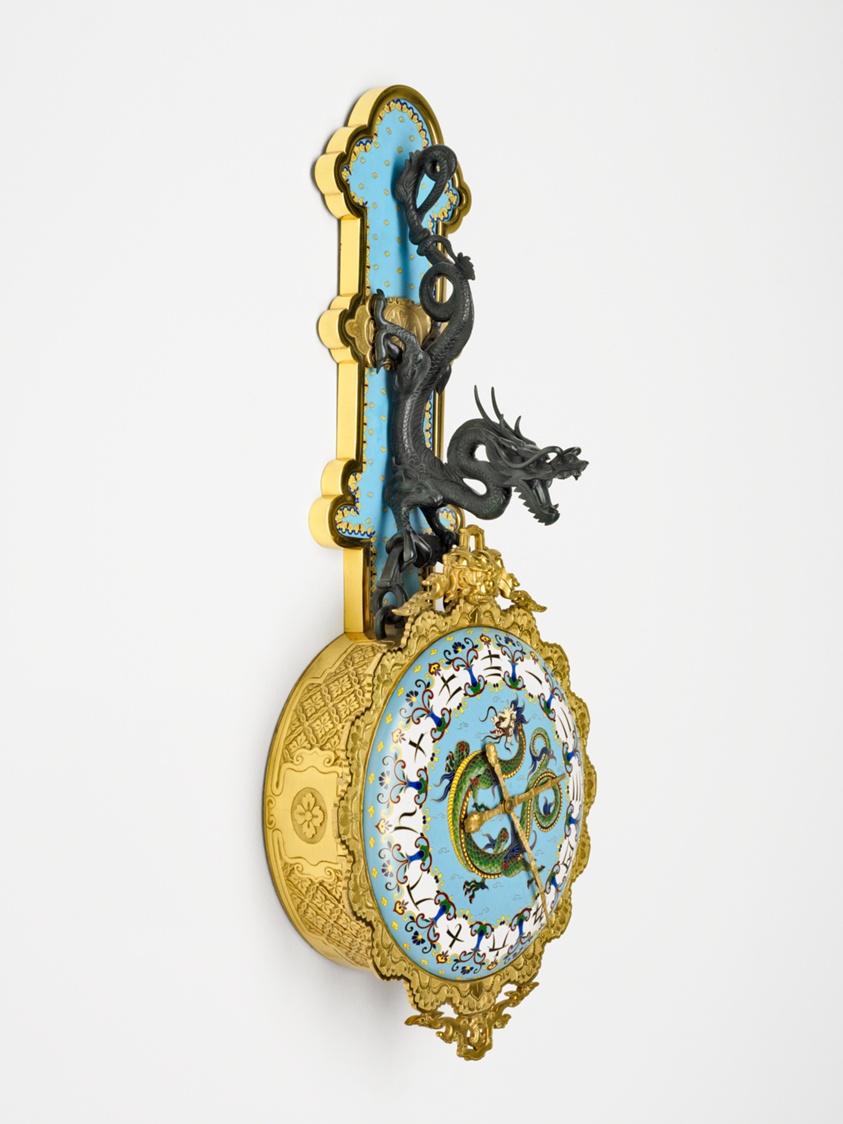
Wall Clock
L’Escalier de Cristal (Paris)
c. 1880
- Medium
- Bronze, gilded bronze, and cloisonné enamel
- Classification
- Metalwork
- Dimensions
- 94 × 40.6 × 22.9 cm (37 × 16 × 9 in.)
- Culture
- France
- Museum
- Art Institute of Chicago, Applied Arts of Europe
- Credit line
- Mary Waller Langhorne Memorial and Harriet A. Fox funds
- Rights
- Public domain (CC0), as the museum states it.
- Who can see it
- Teens profiles and older: its museum says too little about what it shows to place it for younger viewers. How works are placed
View at the Art Institute of Chicago
About this work
This bronze and enamel clock originally came to New York in about 1880 shortly after it had been made in Paris by the firm L’Escalier de Cristal (The Crystal Staircase). It had been acquired for the richest man in America, the railroad magnate William H. Vanderbilt, whose wealth was then estimated at $200 million (about $40 billion in today’s money), and whose lavish mansion was then under construction at 640 Fifth Avenue. Most of the furnishings for the Vanderbilt home were made by Herter Brothers, America’s leading interior decorators, but selected works of art, including this clock, were imported from abroad. Vanderbilt only got to enjoy his opulent home for three years before his death in 1885.
The clock was a central adornment for the Japanese Parlor, one of the most elaborate and exotic interiors made by Herter Brothers. The room deliberately contrasted with the rest of the interiors, which were firmly rooted in European historical styles. Although dubbed a “Japanese” clock, many of the decorations are actually interpretations of Chinese motifs: the dragons in bronze and cloisonné (inlaid enamel) are traditional Chinese symbols of good fortune, and the numbers on the clock…
Description © Art Institute of Chicago, CC BY 4.0