Window mode follows your eyes with your camera, in this browser only: no picture or position leaves your device.
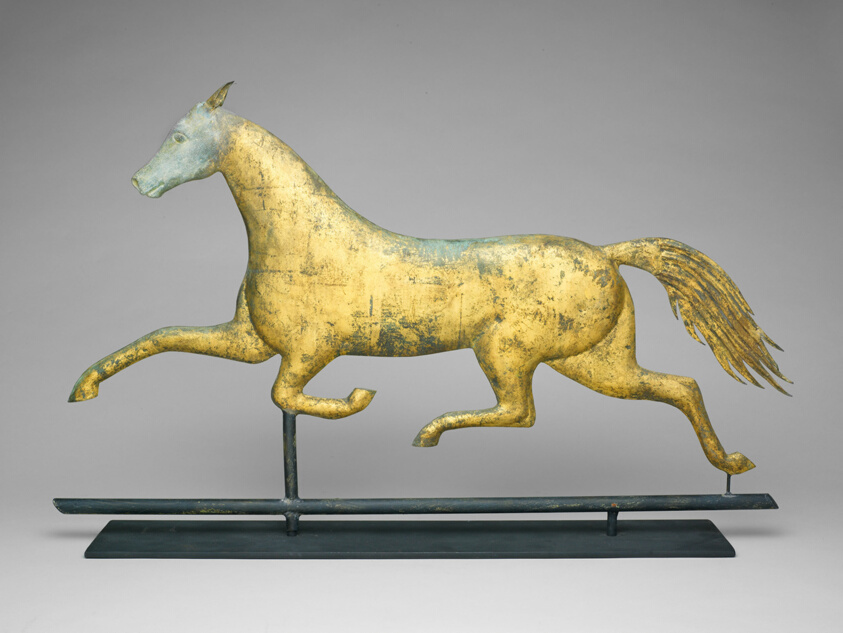
Running Horse Weather Vane
Alvin L. Jewell (A. L. Jewell and Company (American, 1852–67); Waltham, Massachusetts)
c. 1860
- Medium
- Copper, lead or zinc, and gilding
- Classification
- Metalwork
- Dimensions
- 43.2 × 69.2 × 5.1 cm (17 1/16 × 27 1/4 × 2 1/16 in.)
- Culture
- Waltham
- Museum
- Art Institute of Chicago, Arts of the Americas
- Credit line
- Purchased with funds provided by Charles C. Haffner III
- Rights
- Public domain (CC0), as the museum states it.
- Who can see it
- Little Ones profiles and older: it shows gentle subjects for the very young. How works are placed
View at the Art Institute of Chicago
About this work
Before the advent of modern mechanized devices, weather vanes were an important source of information on shifting weather conditions. The horse shape was common; in fact, weather vanes often memorialized famous racehorses. The elegant simplicity of this example is characteristic of the works of Alvin L. Jewell, one of the most important 19th-century weather vane designers. At his metal manufacturing firm, A. L. Jewell and Company, Jewell invented a molding process so that he could mass-produce his handcrafted work. In this example, Jewell made the head of a solid, heavier metal, so the weather vane would balance properly and point toward the wind’s source. Jewell’s innovative manufacturing and advertising methods helped to change the growing American weather vane industry.
Description © Art Institute of Chicago, CC BY 4.0