Window mode follows your eyes with your camera, in this browser only: no picture or position leaves your device.
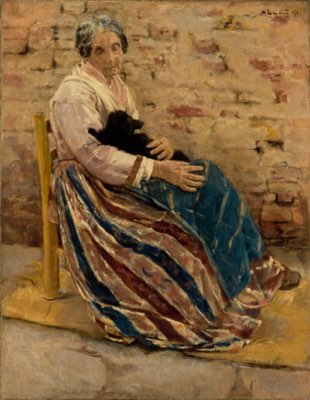
Italienne (Gaëta)
Hilaire Germain Edgar Degas (French, 1834–1917)
1856/57
- Medium
- Graphite, with stumping, on blue wove paper with blue fibers, perimeter-mounted on cream wove paper wrapped around millboard (touch of red chalk)
- Classification
- Drawing and Watercolor
- Dimensions
- 45.6 × 31 cm (18 × 12 1/4 in.)
- Culture
- France
- Museum
- Art Institute of Chicago, Prints and Drawings
- Credit line
- Gift of Dorothy Braude Edinburg to the Harry B. and Bessie K. Braude Memorial Collection
- Rights
- Public domain (CC0), as the museum states it.
- Who can see it
- Teens profiles and older: its museum says too little about what it shows to place it for younger viewers. How works are placed
View at the Art Institute of Chicago
About this work
The young woman who posed for this study probably came from Mola di Gaëta, now known as Formia, a small town in southern Italy. Her heavy dress, with its wide, embroidered sleeves, was typical of the locals. Degas traveled considerably in the vicinity of Rome and Naples in about 1856–59 while, under the sponsorship of the French state, he was a resident at the Villa Medici. Artists slightly senior to Degas had made their name with this kind of imagery, as rural Italian subjects were popular with buyers back in Paris. Although Degas claimed that he was “not mad about this wellknown Italian picturesque,” this drawing shows he was still keen to try the genre.
Description © Art Institute of Chicago, CC BY 4.0