Window mode follows your eyes with your camera, in this browser only: no picture or position leaves your device.
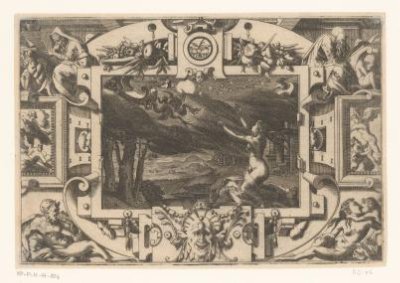
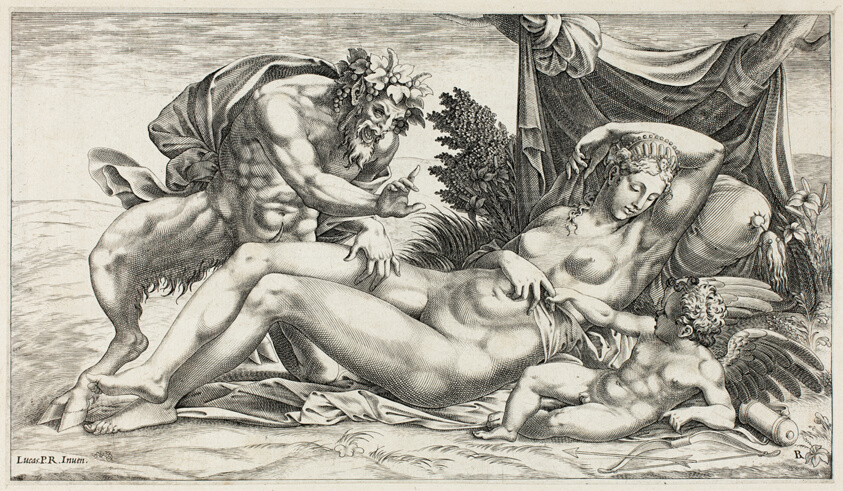
Jupiter and Antiope
René Boyvin (after Luca Penni (Italian, 1500/04-1557))
1550/59
- Medium
- Engraving on ivory laid paper, edge-mounted to ivory laid paper
- Classification
- Dimensions
- Image: 16.2 × 28.6 cm (6 7/16 × 11 5/16 in.); Sheet: 16.6 × 28.8 cm (6 9/16 × 11 3/8 in.); Secondary support: 25.2 × 36.7 cm (9 15/16 × 14 1/2 in.)
- Culture
- France
- Museum
- Art Institute of Chicago, Prints and Drawings
- Credit line
- William McCallin McKee Memorial Endowment
- Rights
- Public domain (CC0), as the museum states it.
- Who can see it
- Teens profiles and older: its subject is for older viewers (war, death, the Passion, drink or the like). How works are placed
View at the Art Institute of Chicago
About this work
René Boyvin’s Jupiter and Antiope is one of his anatomically ambitious reproductive prints based on the work of Luca Penni. It illustrates a story from Greek mythology. Boyvin depicted Antiope resting in a classical pose, with her arm overhead, as Jupiter, in the form of a satyr, stands over her, gesturing to the putto at Antiope’s side not to wake her. The figures are characterized by their accentuated muscles and distorted anatomy, a style typical to the School of Fontainebleau, whose artists were known for their attenuation of the body to create graceful, expressive forms.
Description © Art Institute of Chicago, CC BY 4.0