Window mode follows your eyes with your camera, in this browser only: no picture or position leaves your device.
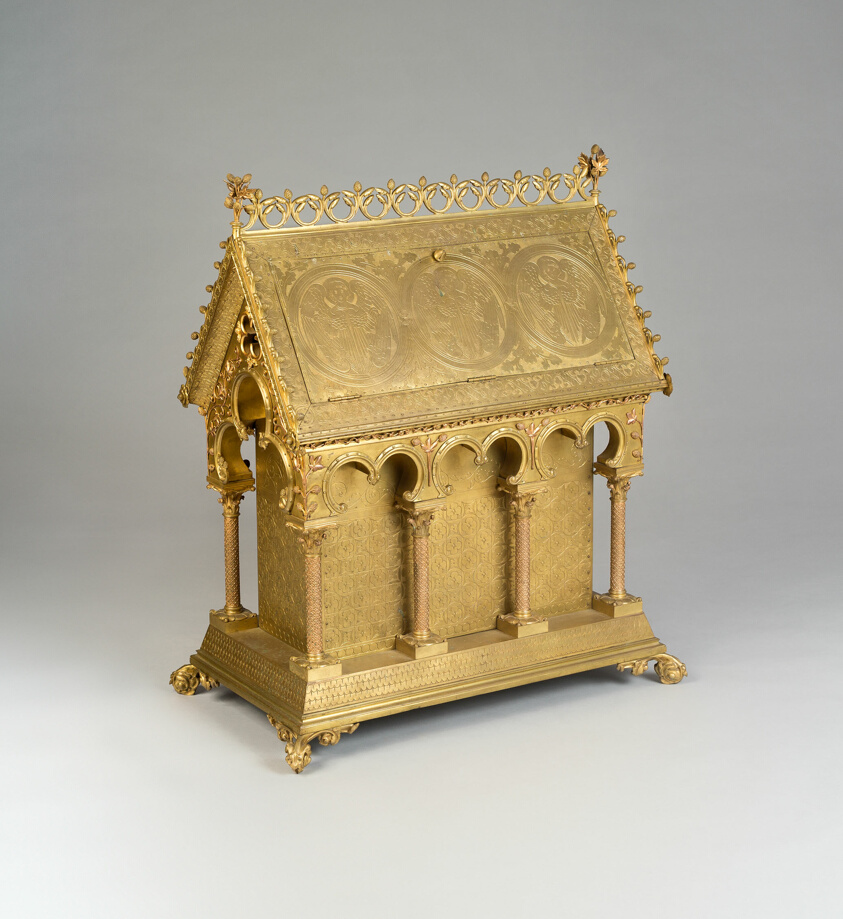
Reliquary
Eugène-Emmanuel Viollet-le-Duc (Made by Louis Bachelet (active France, 1851–about 1880); Paris)
c. 1851
- Medium
- Brass, gilded copper alloy, and wood
- Classification
- Metalwork
- Dimensions
- 88 × 74.2 × 43.2 cm (34 5/8 × 29 1/4 × 17 in.)
- Culture
- Paris
- Museum
- Art Institute of Chicago, Applied Arts of Europe
- Credit line
- Purchased with funds provided by Mary Kathryn Hartigan and the Thomas W. Dower Foundation
- Rights
- Public domain (CC0), as the museum states it.
- Who can see it
- Tweens profiles and older: its subjects are known and suit older children. How works are placed
View at the Art Institute of Chicago
About this work
An expert in historic churches and religious objects, Eugène Viollet-le-Duc likely based the design of this reliquary (a receptacle for sacred relics) on a medieval example with a similar gabled roof also embellished with pinecones, a symbol of eternal life. This object was produced by Louis Bachelet’s foundry, probably as a model that never contained relics. The foundry promoted Viollet-le-Duc’s design through a printed catalogue and in its showroom. The finished reliquaries cost between 2,300 and 2,800 francs (over $40,000 today), depending on the extent of the surface decoration and whether it was varnished or gilded.
Description © Art Institute of Chicago, CC BY 4.0