Window mode follows your eyes with your camera, in this browser only: no picture or position leaves your device.
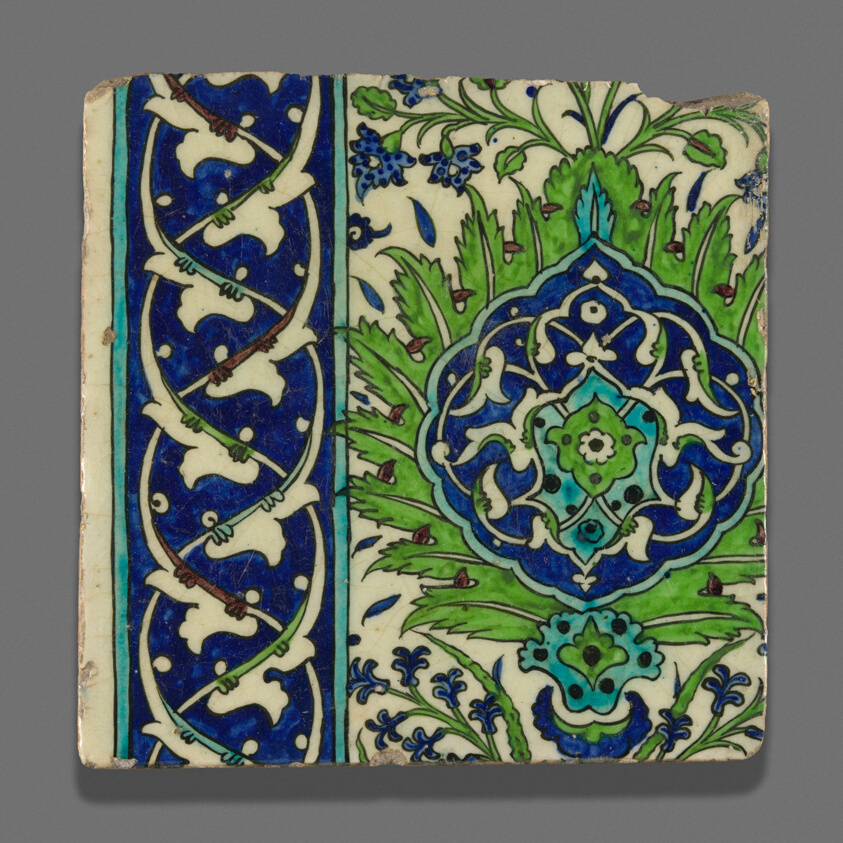
Tile with Floral Design
Ottoman dynasty (1299–1923), 16th/17th century
- Medium
- Fritware with polychrome painting under transparent glaze
- Classification
- Architectural fragment
- Dimensions
- 27.3 × 27 × 2.3 cm (10 3/4 × 10 11/16 × 7/8 in.)
- Culture
- Damascus
- Museum
- Art Institute of Chicago, Arts of Asia
- Credit line
- Logan-Patten-Ryerson Collection
- Rights
- Public domain (CC0), as the museum states it.
- Who can see it
- Little Ones profiles and older: it shows gentle subjects for the very young. How works are placed
View at the Art Institute of Chicago
About this work
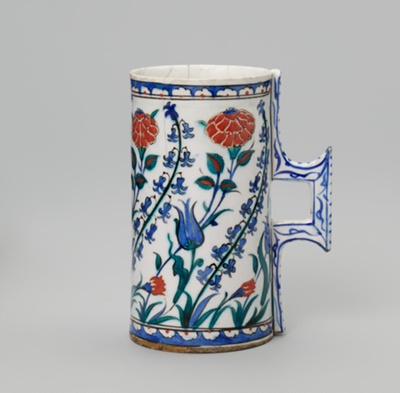
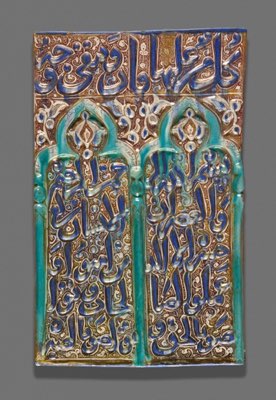
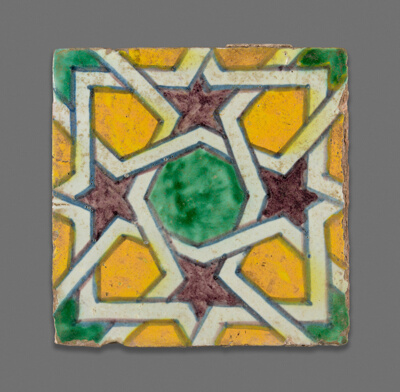
This tile belongs to group of ceramics sometimes referred to as Damascus or Syrian ware that are closely related to Iznik ceramics. These wares were produced in Damascus in the mid-16th century when the Ottoman sultan, Suleyman the Magnificent, sent Iznik potters to repair and restore tilework at the Dome of the Rock in Jerusalem. After refurbishing the tilework, these artisans settled in Damascus, where they continued to produce tiles and vessels. While similar in style to the tiles produced in Iznik, tiles made in Syria in the Ottoman period employ a different color palette to depict vegetal and geometric forms. Syrian ceramics did not use the crisp white ground and only rarely used the vibrant tomato red typical of Iznik ceramics. Instead, Syrian tilework tended toward a more muted color palette of natural greens and blues.
Description © Art Institute of Chicago, CC BY 4.0