Window mode follows your eyes with your camera, in this browser only: no picture or position leaves your device.
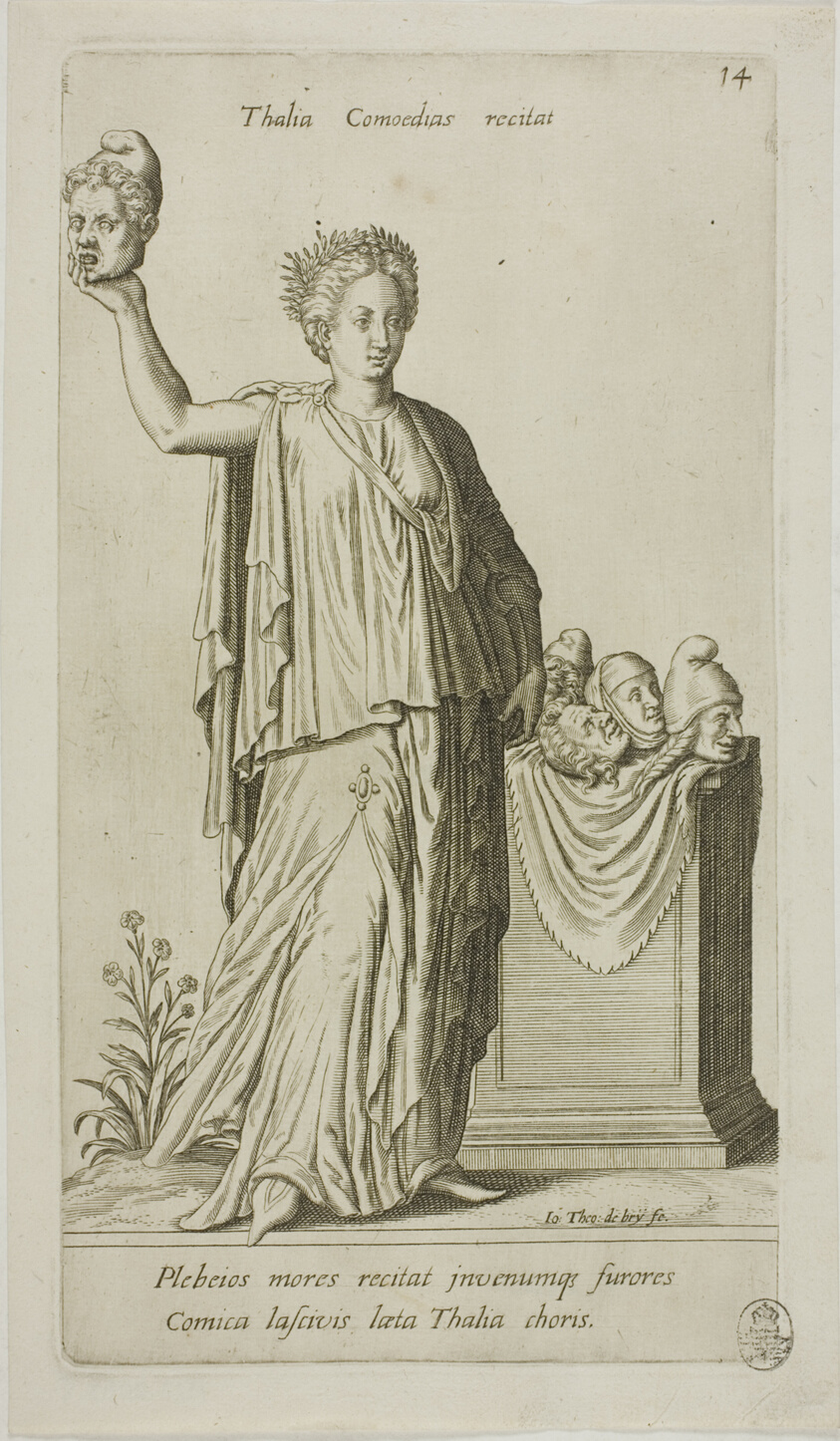
Thalia, Muse of Comedy, plate 14 from Parnassus Biceps
Johann Theodor de Bry (after Jean-Jacques Boissard (French, 1533–1598))
1601
- Medium
- Engraving in black on ivory laid paper
- Classification
- Dimensions
- Image: 23.2 × 14 cm (9 3/16 × 5 9/16 in.); Plate: 25.8 × 14 cm (10 3/16 × 5 9/16 in.); Sheet: 28 × 16.3 cm (11 1/16 × 6 7/16 in.)
- Culture
- Frankfurt an der Oder
- Museum
- Art Institute of Chicago, Prints and Drawings
- Credit line
- The Wallace L. DeWolf and Joseph Brooks Fair Collections
- Rights
- Public domain (CC0), as the museum states it.
- Who can see it
- Teens profiles and older: its subject is for older viewers (war, death, the Passion, drink or the like). How works are placed
View at the Art Institute of Chicago
About this work
In Greek mythology, the nine Muses governed the arts and music. Melpomene, in the print on the left (see 1920.2037), was the protector of tragedy; her counterpart Thalia, Muse of comedy and bucolic poetry, is visible on the right. Each Muse holds a mask—a tragic mask for Melpomene, a comic one for Thalia. Behind Thalia, a pedestal is piled with other comic masks. The duality of tragedy and comedy as manifested in these two deities brings to mind the universally recognizable image of the laughing and weeping faces used to symbolize theater today.
Description © Art Institute of Chicago, CC BY 4.0