Commemorative Head
Edo (Nigeria; Coastal West Africa)
Probably mid–17th/mid–18th century
- Medium
- Terracotta
- Classification
- Sculpture
- Dimensions
- 30.5 × 14 × 16.6 cm (12 × 5 1/2 × 6 1/2 in.)
- Culture
- Nigeria
- Museum
- Art Institute of Chicago, Arts of Africa
- Credit line
- Gift of Richard Faletti, the Faletti Family Collection
- Rights
- Public domain (CC0), as the museum states it.
- Who can see it
- Tweens profiles and older: its subjects are known and suit older children. How works are placed
View at the Art Institute of Chicago
About this work
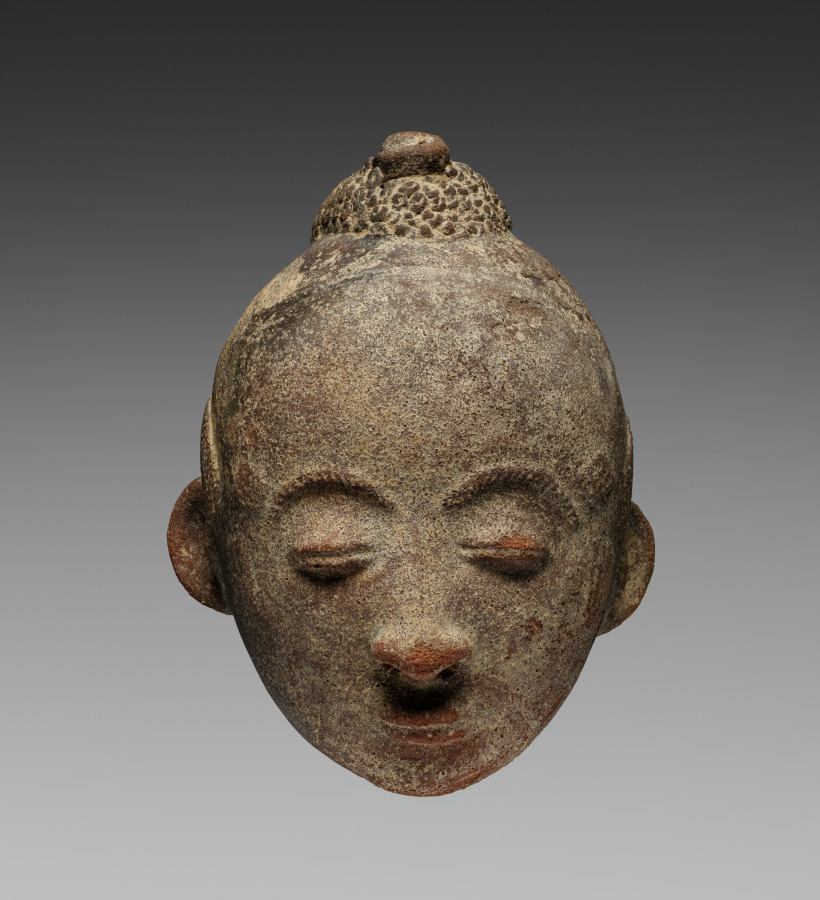
Benin brass-casters traditionally make commemorative heads in both terracotta and brass. This terracotta head is distinguished by its fleshy, idealized facial features, scarification patterns above each eye, stylized hairstyle—arranged in a series of horizontal rows—and snuggly worn beaded collar. The fullness of the cheeks is best perceived from a profile view, and the delicate modeling of the eyes, nose, and lips testifies to the sensitivity and skill of the artist.
In the Kingdom of Benin, in southeastern Nigeria, the creation and display of ancestral commemorative heads is an ancient practice extending back to the first dynasty, before the 14th century. The heads were made of different materials to suit the varied political and social status of their owners. Sometime after the 14th century royal commemorative heads were cast in brass; however, oral tradition suggests that terracotta heads adorned royal altars at an earlier time. More recently, terracotta heads have functioned to commemorate important members of the brass-casters’ guild, adorning their ancestral altars.
Like the brass commemorative heads, this terracotta head has a hole on the crown. In the case of the brass…
Description © Art Institute of Chicago, CC BY 4.0