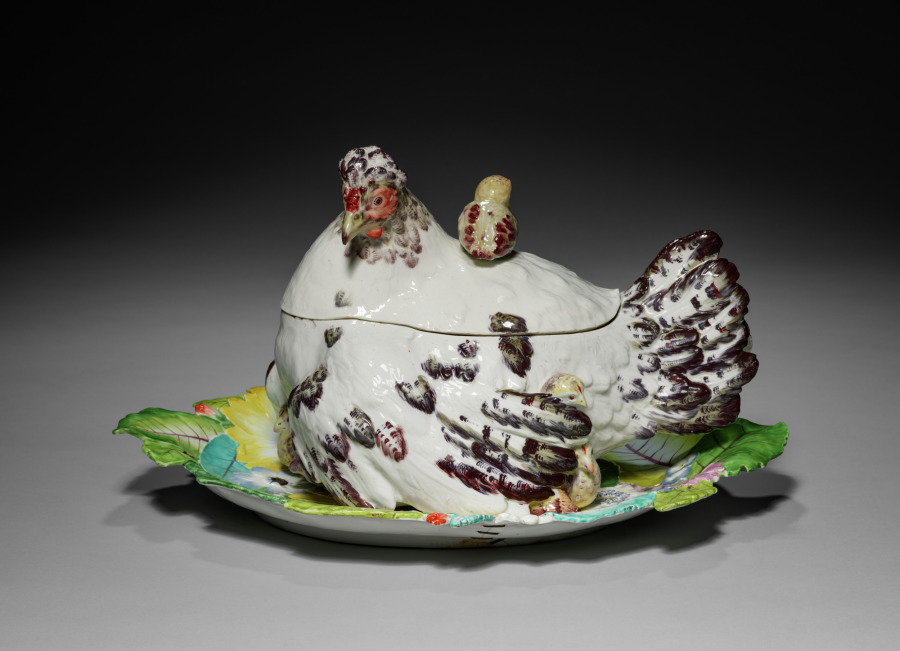
Oil or Vinegar Cruet
Meissen Porcelain Manufactory (Model by Johann Joachim Kändler (born Saxony [now Germany], 1706–1775); Meissen, Electorate of Saxony (now Germany))
c. 1737
- Medium
- Enameled and gilded hard-paste porcelain
- Classification
- Ceramics
- Dimensions
- 21.3 × 16.1 × 9.3 cm (8 3/8 × 6 5/16 × 3 5/8 in.)
- Culture
- Meissen
- Museum
- Art Institute of Chicago, Applied Arts of Europe
- Credit line
- Gift of Mr. and Mrs. Samuel Grober in honor of Ian Wardropper and Ghenete Zelleke through the Antiquarian Society
- Rights
- Public domain (CC0), as the museum states it.
- Who can see it
- Tweens profiles and older: its subjects are known and suit older children. How works are placed
View at the Art Institute of Chicago
About this work
Typifying the splendor of the Saxon court at Dresden during the eighteenth century, this porcelain centerpiece would have been part of an elaborate dinner service that graced ceremonial court banquet tables. Remarkable for its large size and luxurious decoration, the service was designed for Count Heinrich von Brühl, who was both administrator of the Royal Saxon Porcelain Manufactory at Meissen and prime minister to Augustus III (r. 1733–63), elector of Saxony and king of Poland. The centerpiece consists of a large, flat plateau made in sections fitted together to support a tall, four-legged, open basket decorated with fanciful roosters and Chinese figures. At either end of the plateau are sugar casters in the form of Chinese figures embracing under a canopy. Established in 1710, the Meissen factory dominated porcelain production in Europe until the mid-eighteenth century and continues to operate to this day.
Description © Art Institute of Chicago, CC BY 4.0