Window mode follows your eyes with your camera, in this browser only: no picture or position leaves your device.
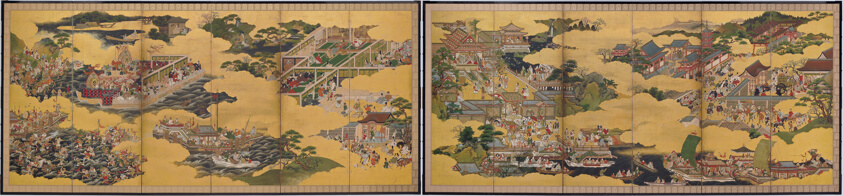
The Tale of Taishokan
Artist unknown (Japanese)
1640-80
- Medium
- Pair of six-panel screens; ink, colors, and gold on paper
- Classification
- Painting
- Dimensions
- Each: 173 × 374 cm (68 1/8 × 147 1/4 in.)
- Culture
- Japan
- Museum
- Art Institute of Chicago, Arts of Asia
- Credit line
- Restricted gift of Charles C. Haffner III and Muriel Kallis Newman; Alyce and Edwin DeCosta and Walter E. Heller Foundation Endowment; through prior gift of Charles C. Haffner III
- Rights
- Public domain (CC0), as the museum states it.
- Who can see it
- Teens profiles and older: its museum says too little about what it shows to place it for younger viewers. How works are placed
View at the Art Institute of Chicago
About this work
This screen narrates the medieval Taishokan tale, an action-adventure story that captivated medieval and early modern audiences whether they saw it performed on the Noh, Bunraku or Kabuki stage, or depicted in paintings and prints. The many variants of the tale combine elements from early Japanese mythology and history; 14th-century Buddhist temple origin legend (engi) that reflects continuing anxiety about foreign invasion in the wake of the Mongol attacks of the late 13th century, and Noh play motifs. The story unfolds from right to left, opening with a scene in and around the courtyard of Fujiwara Kamatari’s residence in the Nara area. Kamatari, the most powerful courtier of the seventh century, was the first and only person ever granted the rank of ‘Taishokan,’ the highest rank in a system used only between 647 and 685. According to legend, reputation of Kamatari daughter’s beauty made its way to China, where the emperor Taizong fell in love with her sight unseen, and asked to marry her. Kamatari’s daughter, Kohakunyo, is shown boarding her carriage to be sent abroad on the ships depicted below. Her new home, the Chinese court, is shown to the left. On the left screen, the…
Description © Art Institute of Chicago, CC BY 4.0