Window mode follows your eyes with your camera, in this browser only: no picture or position leaves your device.
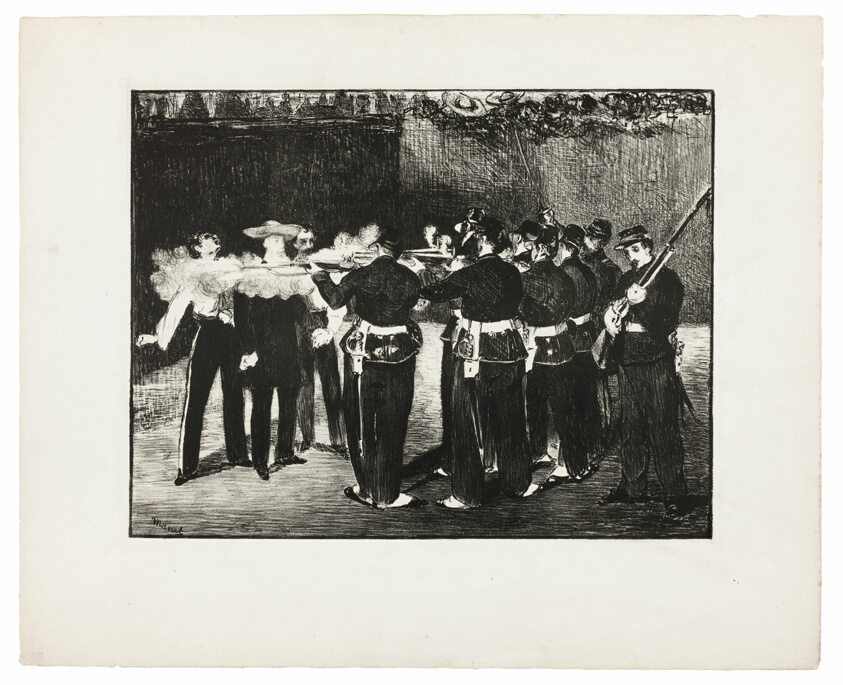
The Execution of Maximilian
Édouard Manet (French, 1832-1883)
1867–68
- Medium
- Lithograph in black, with scraping, on ivory chine laid down on ivory wove paper
- Classification
- Dimensions
- Image: 33.5 × 43.4 cm (13 1/4 × 17 1/8 in.); Primary support: 33.8 × 43.6 cm (13 5/16 × 17 3/16 in.); Secondary support: 49 × 59.9 cm (19 5/16 × 23 5/8 in.)
- Culture
- France
- Museum
- Art Institute of Chicago, Prints and Drawings
- Credit line
- William McCallin McKee Memorial Endowment
- Rights
- Public domain (CC0), as the museum states it.
- Who can see it
- Adult profiles and older: its museum's description or title mentions violence, death or gore. How works are placed
View at the Art Institute of Chicago
About this work
The young Austrian-born Archduke Ferdinand Maximilian Joseph was controversially installed as Emperor Maximilian I of Mexico in 1864 in an attempt to create a European-style monarchy there, backed by Napoleon III of France and a cohort of monarchists. Seen as part of a European imperialist campaign, Maximilian’s rule was considered illegitimate by those who opposed the French occupation of Mexico. This work interprets the young ruler’s execution in Querétero, Mexico, on June 19, 1867, alongside generals Miguel Miramón (left) and Tomás Mejía (right). Édouard Manet’s composition was inspired by not only history painting and the iconography of Francisco de Goya but also contemporary journalism and the budding field of newspaper photography. One controversial aspect of this print is the presence of French troops in the firing squad rather than those of the Mexican Republic. The lithograph was censored by the French government and was not publicly printed until after Manet’s death.
Description © Art Institute of Chicago, CC BY 4.0