Window mode follows your eyes with your camera, in this browser only: no picture or position leaves your device.
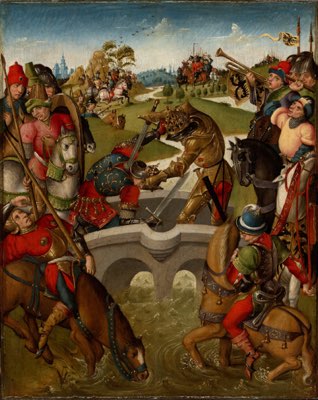
Emperor Heraclius Denied Entry into Jerusalem
c. 1470
- Medium
- Tempera and oil on panel
- Classification
- Painting
- Dimensions
- 67.6 × 54.2 cm (26 5/8 × 21 5/16 in.); Framed: 76.2 × 62.6 × 5.1 cm (30 × 24 5/8 × 2 in.)
- Culture
- Netherlands
- Museum
- Art Institute of Chicago, Painting and Sculpture of Europe
- Credit line
- George F. Harding Collection
- Rights
- Public domain (CC0), as the museum states it.
- Who can see it
- Teens profiles and older: its subject is for older viewers (war, death, the Passion, drink or the like). How works are placed
View at the Art Institute of Chicago
About this work
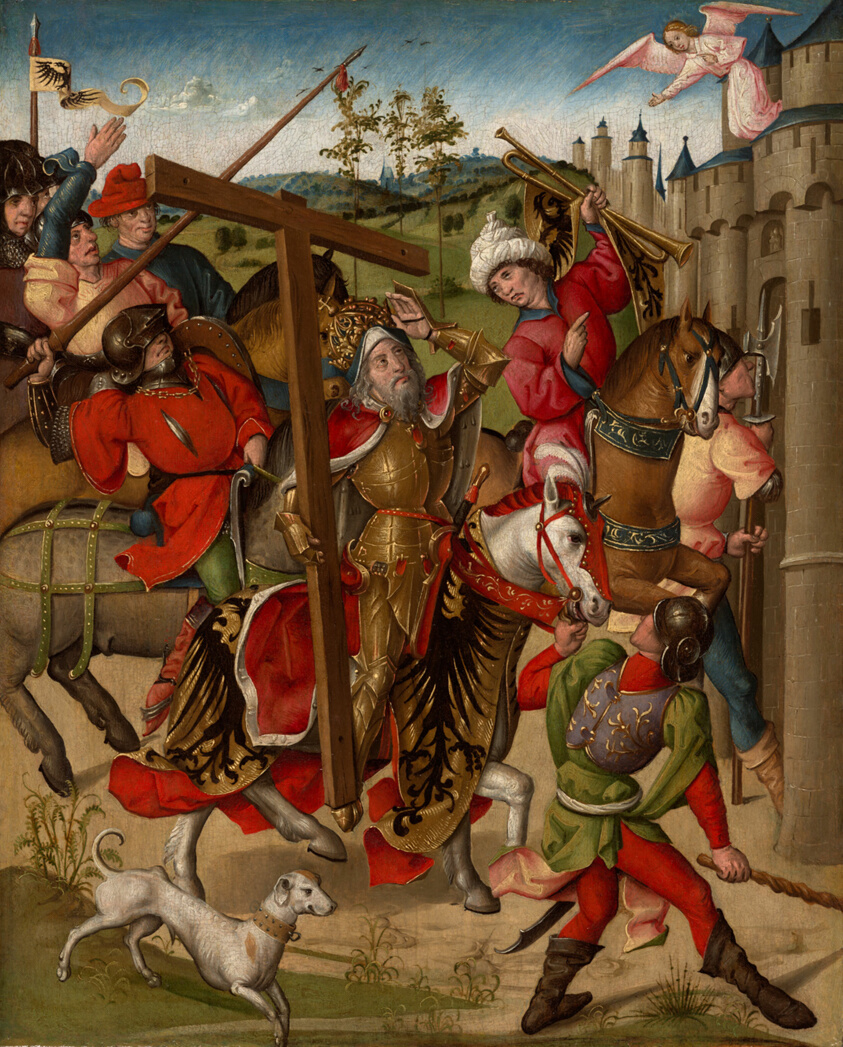
This panel recounts the adventures of the Byzantine emperor Heraclius, who rescued the True Cross and returned it to Jerusalem after its capture by Chosroës, king of Persia. These scenes were probably part of an extended narrative on an altarpiece dedicated to the Holy Cross, a relic that was much venerated in the Middle Ages.
In this scene, the emperor brings the True Cross back to Jerusalem in triumph. However, an angel bars his way, pointing out the vanity of his procession in comparison to Christ’s humble entry into the city. Only when the emperor dismounted and approached in humility was he allowed to enter, a scene that was no doubt once part of the sequence. Here the emperor is identifiable by the double-headed eagle, which was an emblem of both the Holy Roman emperor of the day and past emperors.
Description © Art Institute of Chicago, CC BY 4.0