Window mode follows your eyes with your camera, in this browser only: no picture or position leaves your device.
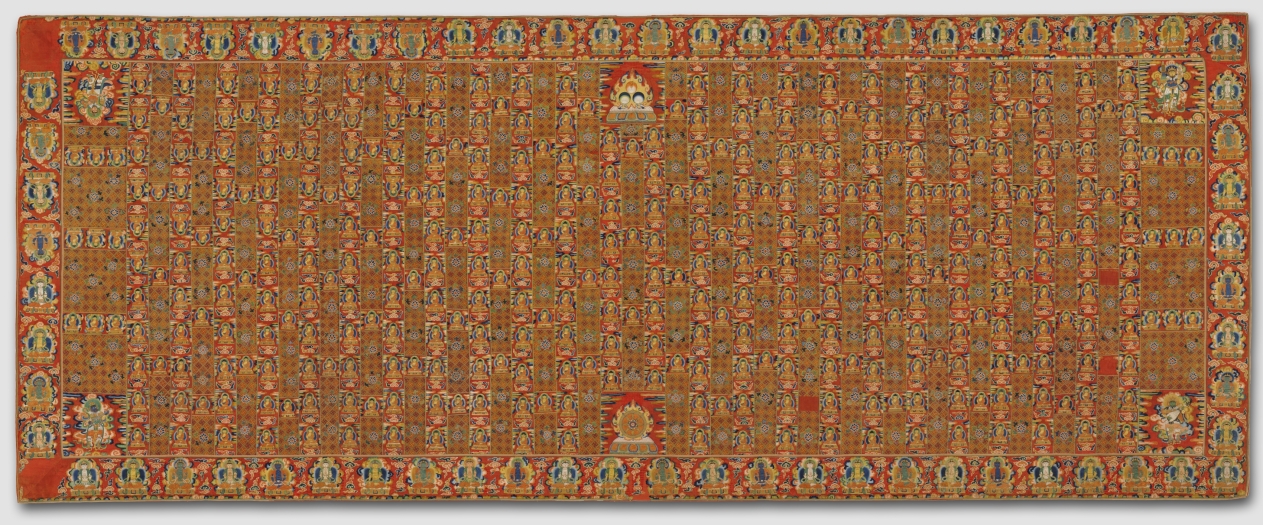
Altar Frontal
1480-1550
- Medium
- Silk, warp-float faced 3:1 'Z' twill weave with supplementary discontinuous facing brocading wefts forming areas of weft loops (known as bouclé) tied by secondary binding warps in weft-float faced 3:1 twill interlacing and supplementary…
- Classification
- Religious/Ritual Object
- Dimensions
- 100.8 × 203.4 cm (39 3/4 × 80 1/8 in.) Repeat: 84.4 × 56.5 cm (33 1/4 × 22 1/4 in.)
- Culture
- Spain
- Museum
- Art Institute of Chicago, Textiles
- Credit line
- Kate S. Buckingham Endowment
- Rights
- Public domain (CC0), as the museum states it.
- Who can see it
- Tweens profiles and older: its subjects are known and suit older children. How works are placed
View at the Art Institute of Chicago
About this work
Velvets fabrics often formed the foundation for the most sumptuous liturgical textiles used by European clergy. The altar frontal, a cloth that covers the front of the altar table, was once decorated with embroidery and it was likely part of a coordinating set of liturgical objects that include priests’ apparel and accessories. Variations of this popular velvet pattern were woven in both Italy and Spain and produced for many decades. A kaftan made of this design was part of the vast wardrobe of the Ottoman Sultan Ahmed I (r. 1603–17).
Description © Art Institute of Chicago, CC BY 4.0