Window mode follows your eyes with your camera, in this browser only: no picture or position leaves your device.
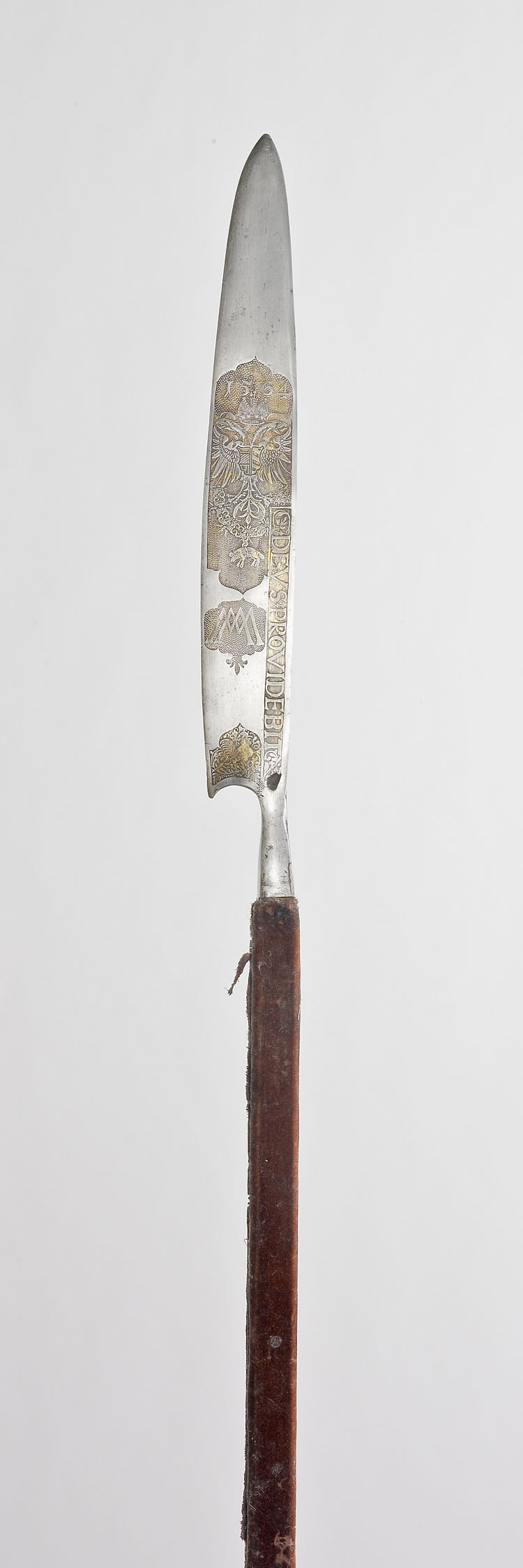
Glaive for the Bodyguard of Emperor Maximilian II
1564
- Medium
- Steel, iron, gilding, oak, and silk textile (velvet)
- Classification
- Arms
- Dimensions
- H.: 215.9 cm (85 in.); Blade with socket: H.: 62.6 cm (24 5/8 in.)
- Culture
- Austria
- Museum
- Art Institute of Chicago, Applied Arts of Europe
- Credit line
- George F. Harding Collection
- Rights
- Public domain (CC0), as the museum states it.
- Who can see it
- Teens profiles and older: its subject is for older viewers (war, death, the Passion, drink or the like). How works are placed
View at the Art Institute of Chicago
About this work
Pole arms (staff weapons) were used not only in warfare and hunting, but also in sporting combat and ceremonies. The term refers to a family of edged weapons attached to wooden staffs. With the exception of the lance, which remained the weapon of the mounted knight, all other staff weapons were wielded by men on foot by 1600. With the development of firearms and their introduction as infantry weapons, pole arms lost their importance on the field, and from the mid-16th century, they were reserved for use in sporting contests and by princely bodyguards for ceremony and parade. The blades lent themselves to embellishment—engraving, etching, or other forms of decoration—and provided a perfect surface for the coats of arms of noble or princely families. The ceremonial use of staff weapons continues to this day with the Swiss Guards at the Vatican and Britain’s Yeomen of the Royal Guard.
Description © Art Institute of Chicago, CC BY 4.0