Window mode follows your eyes with your camera, in this browser only: no picture or position leaves your device.
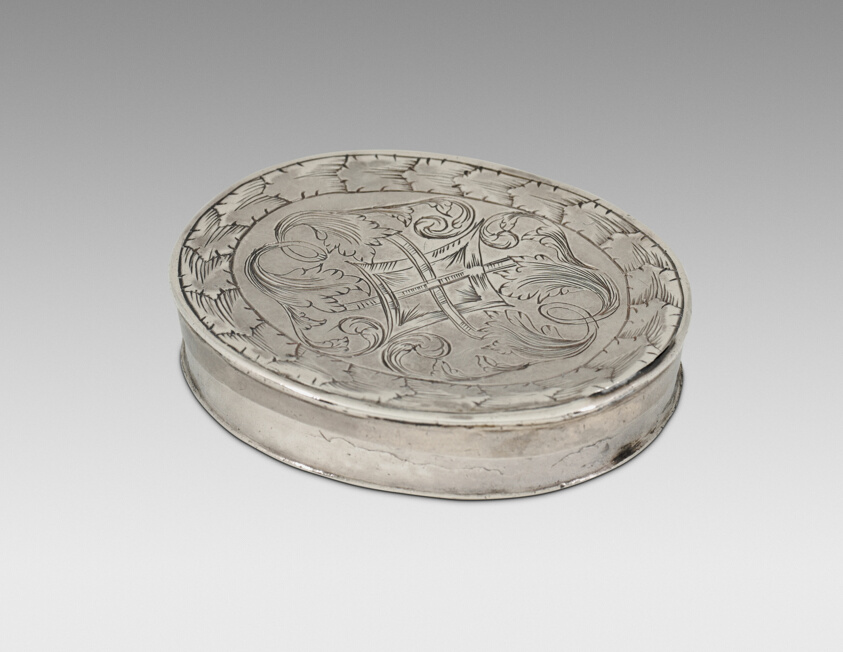
Patch Box
Artist unknown (Probably Newport, Rhode Island)
1710–30
- Medium
- Silver
- Classification
- Metalwork
- Dimensions
- 2 × 5.1 × 7.6 cm (7/16 × 2 × 3 1/8 in.)
- Culture
- Newport
- Museum
- Art Institute of Chicago, Arts of the Americas
- Credit line
- Purchased with funds provided by Warren L. Batts
- Rights
- Public domain (CC0), as the museum states it.
- Who can see it
- Teens profiles and older: its museum says too little about what it shows to place it for younger viewers. How works are placed
View at the Art Institute of Chicago
About this work
Patch boxes were popular accessories for both men and women in the eighteenth century. They were used to hold artificial beauty marks, or patches, which were applied to the face, sometimes over blemishes or smallpox scars. These patches were commonly made out of black paper, velvet, or silk that could be cut into a variety of shapes and designs. Placing patches on specific areas of the face held different meanings. For instance, one placed at the corner of the eye was supposed to evoke passion.
Description © Art Institute of Chicago, CC BY 4.0