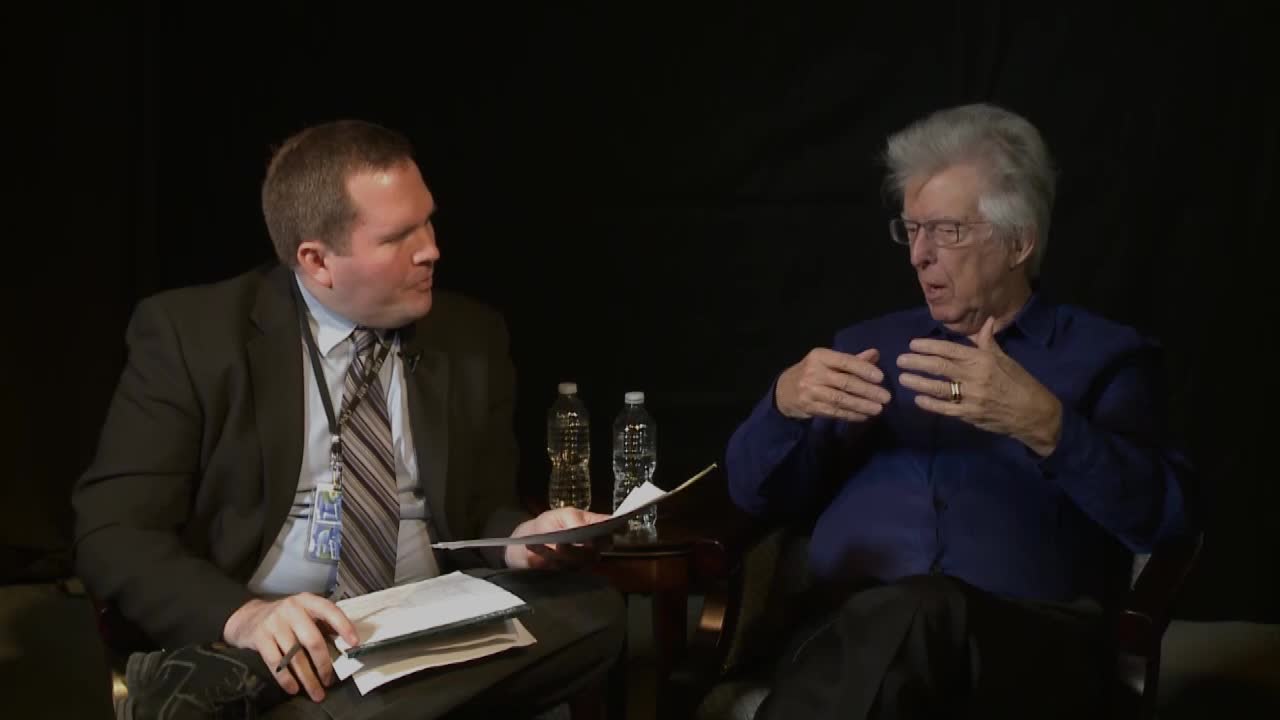
Strategies for the Realization of Sound Spatialization
Library Of Congress. Music Division
Music
Clips are not offered for this film: the Library of Congress states its rights in its own words, not as a public licence, which leaves reuse unclear.
Parts
About
In a series of wide-ranging interviews and discussions, Roger Reynolds discusses various threads woven through his life and music. They include the use of text, thoughts on sound spatialization, site-specifics works, intermedia, technology in music, his compositional methods, and relationships with other composers (including Iannis Xenakis, Toru Takemitsu, John Cage, and Elliott Carter). Composer, author and educator Roger Reynolds is University Professor at the University of California, San Diego. The Roger Reynolds Collection is held at the Library of Congress, and contains manuscripts, sketches, correspondence, recordings and other primary source materials related to Reynolds' life and work. Part 8 of this series further explores aspects of spatialization in the music of Roger Reynolds, invoking works like Personae, Versions/Stages, The Red Act Arias, and MARKed MUSIC to illustrate concepts. Reynolds is interviewed by David Plylar of the Music Division, and their discussion covers topics such as conveying spatial concepts to performers and audiences, images as sources of inspiration, issues related to the perspectives and psychology of listeners in a sound field, form and content in the spatial realm, links between Reynolds' and Claude Monet's work, the relative effectiveness of gross vs. elegant realizations of spatialization, acoustic "scene design," technological collaborations, and the enhanced musical status the electronic musician gains as a realtime manipulator of…
Human-made No record of this work says a model made it. What this means.
- Archive
- Library of Congress, in Library of Congress: talks and concerts
- Licence or status
- Rights statement at the Library of Congress, as the Library of Congress states it.
- Credit
- Library of Congress
- Language
- English
- Country
- United States
- Who can watch
- The archive gives no rating. Invisible Network shows it to Tweens profiles and older, judged from its collection and subjects. How films are placed
More from Library of Congress: talks and concerts
 Talk
Rev. Robert B. Jones Sr. Concert
 Talk
The Azevedo Collection: Musical and Cultural Exchange Between Brazil and the U.S.
 Talk
Introduction to ‘The Jazz Loft According to W. Eugene Smith’
 Talk
Northern Resonance: Scandinavian Roots Music
 Talk
Instrument of the State: A Century of Music in Louisiana’s Angola Prison
 Talk
He Came, He Saw, He Concord: Technique and Texture in the Music of Ives and Ravel
 Talk
From Folk to Baroque: Celtic Music Duo Rakish
 Talk
Conversation with Istiwanāt Live Arabic Music Ensemble
 Talk
Library of Congress Chorale: Reel Music
 Talk
Istiwanāt Live Arabic Music Ensemble
 Talk
Sidney Robertson, Folk Music Collecting and FDR’s New Deal
 Talk