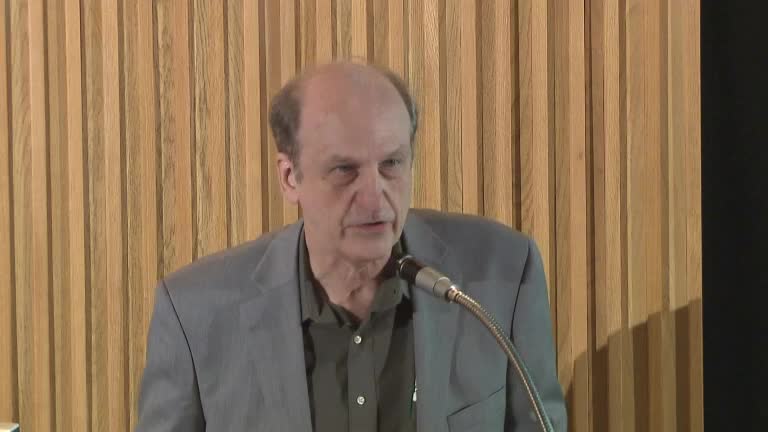
Memorialization & Justice as an Ancestral Imperative: Two American Cases
American Folklife Center
History
Clips are not offered for this film: the Library of Congress states its rights in its own words, not as a public licence, which leaves reuse unclear.
Parts
About
The role of orally transmitted ancestral memory in ongoing struggles to overcome past injustices is proving critical in the struggle for human rights, civil rights and justice. In this context, the presentation reflects on two path-breaking cases of recent public memorialization: the Moiwana Massacre, which took place in the Republic of Suriname, South America and the Sand Creek Massacre in Colorado.
Human-made No record of this work says a model made it. What this means.
- Archive
- Library of Congress, in Library of Congress: talks and concerts
- Licence or status
- Rights statement at the Library of Congress, as the Library of Congress states it.
- Rights statement
- While the Library of Congress created most of the videos in this collection, they include copyrighted materials that the Library has permission from rightsholders to present. Rights assessment is your responsibility. The written permission of the copyright owners in materials not in the public domain is required for distribution, reproduction, or other use of protected items beyond that allowed by fair use or other statutory exemptions. There may also be content that is protected under the copyright or neighboring-rights laws of other nations. Permissions may additionally be required from holders of other rights (such as publicity and/or privacy rights). Whenever possible, we provide information that we have about copyright owners and related matters in the catalog records, finding aids and other texts that accompany collections. However, the information we have may not be accurate or…
- Credit
- Library of Congress
- Language
- English
- Country
- United States
- Who can watch
- The archive gives no rating. Invisible Network shows it to Adult profiles and older, judged from its collection and subjects. How films are placed
More from Library of Congress: talks and concerts
 Talk
History of Science Society Conference
 Talk
Sagas and Daily Life in the Icelandic Commonwealth, Part III
 Talk
Sagas and the Icelandic Manuscript Tradition
 Talk
Sagas and Daily Life in the Icelandic Commonwealth, Part I.
 Talk
Sagas and Daily Life in the Icelandic Commonwealth, Part II
 Talk
Voyages and Travel in Medieval Europe as Depicted in Saga Literature
 Talk
Influence of the Sagas on Modern Nordic Literature
 Talk
Saga Literature and Its Relation to Modern Visual Arts and Music
 Talk
Jefferson and His Legacy
 Talk
Introductory Remarks - James Madison: Philosopher & Practitioner of Liberal Democracy
 Talk
James Madison, Federalist
 Talk