U.S. NAVY T2V-1 JET TRAINER DESIGN AND PERFORMANCE FILM 84304
Industrial and advertising
Clips are not offered for this film: no licence or public-domain mark is recorded for it.
Low resolution (632×360): this is the archive's own copy.
Parts
About
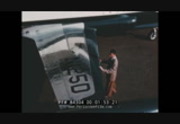
This film familiarizes the viewer with the Lockheed T2V SeaStar, later called the T-1 SeaStar, a turbojet trainer aircraft for the U.S. Navy that entered service in May 1957. It was developed from the Lockheed T-33 and powered by one Allison J33 engine.
As the year 1955 began, Lockheed Aircraft Corporation had design built and delivered to the arm forces more than 6,000 jet fighter and trainer. Of this total the trainer accounted for more than 300 planes including air force T33 and navy TV2s. this is seen at mark 0:48. As these aircrafts pile up the Lockheed Aircraft Corporation worked In conjunction directly with personnel’s in charge of operational commands obtaining information as to how to improve the design as seen at mark 01:20. They made research on how the flight could be simplified and most of all how safety, reliability and performance could be bettered.
At mark 1:35, we have a demonstrating model of a new jet trainer which was built with the company’s own funds. This air plane has some basic improvement in contrast with the TV2. At mark 1:46, we see its air intake docks which offers maximum efficiency in air recovery and also wind slash which helps to improve its speed flight characteristics; also helps in free floating. The cockpit is also widened to increase working space. It was raised 6-inches. At mark 02:39, we have the take off of the air craft to check for the flight test. Also the wings of the aircraft were tested. At mark 4:00, we have the navy’s interest in the new trainer increased and the modification required to adapt to operations are been tested. At mark 4:22, we have the wing test, the landing on a simulator was also tested for as seen at mark 4:31. The main gear was doubled to normal landing gear. At mark 5:05, a series of test are run to improve the shock absorber and also to minimize hook bounds. This trainer will accept alternate engines which include the J-33A-24 with 6,100 pounds of thrust or the J-48-P8A with 7,250 pounds of thrust as seen at mark 5:27.
At mark 5:32, we have the first design of the T2V1 jet trainer which was ready for flight in 3 months. It is an all new aircraft which meets all training command requirements for advanced single engine instrument training. The wing slash were redesigned and also the rear and windscreens. The flight controls duplicated are also mechanically linked as seen at mark 6:34. At mark 6:53, we can see the single point fuelling system which makes it completely fuelled to capacity in 5 minutes. We also see the sequence of fuel transfer. At mark 7:45, we have the T2V-1 making a ground maneuvering which shows a satisfactory ground handling characteristics. It has a combat weight of 16,705 lbs, ground run of 1880 feet and it clears 50- foot obstacle at 3040 feet. Maximum rate of climb at sea level is 5500 ft per minute as seen at mark 8:27. In 11.1 minutes, it can climb up to 35,000 feet which is 1700 feet per minute. Its maximum speed at sea level is 485 knots and its combat ceiling 45000 feet. The range of the craft with reserve is 785 nautical miles as seen at mark 9:15. At mark 9:34, we have the design made in the wing flap which reduce the stalling speed of the craft by 8 knots and increases its maximum lift coefficient by 18% at maximum power. The flight trainer meets the CVL operational demands in all respects wherein its landing stress and catapult stress will not exceed flight deck strength. As seen at mark 10:20, its crane capacity does not exceed CVL crane capacity and it will fit on CVL elevators without exceeding lift capacity and without need for falling wings. At mark 11:00, we have the wing slash of the craft been tested. At mark 11:11 we see its extended lateral stability in level flight. At mark 12:30 we have the landing weight with ground run of 1820 feet and with boundary layer control in operation shortened to 720 feet. At mark 12:44, we have the navy air test facility in California where the suitability test was undertaken for the aircraft to finalize the design of the air plane courier equipment. At mark 13:27, we have the landing and afterwards a slow motion of an in-air landing demonstration. Its features and capabilities permits it to be used early in the flight training curriculum and it may also be employed for fleet carrier jet transition training. It may also be used for periodic instrument training, combat readiness training and carrier to shore utility transition also others as seen at mark 15:20.
This film is part of the Periscope Film LLC archive, one of the largest historic military, transportation, and aviation stock footage collections in the USA. Entirely film backed, this material is available for licensing in 24p HD and 2k. For more information visit http://www.PeriscopeFilm.com
Human-made No record of this work says a model made it. What this means.
- Archive
- Internet Archive, in Ephemeral films
- Licence or status
- The Internet Archive states none for this item.
- Language
- English
- Who can watch
- The archive gives no rating. Invisible Network shows it to Tweens profiles and older, judged from its collection and subjects. How films are placed