U.S. ARMY BATTLE OF THE BULGE DOCUMENTARY "TIGERS ON THE LOOSE" PART 2 80814
DocumentaryIndustrial and advertising
Clips are not offered for this film: no licence or public-domain mark is recorded for it.
Low resolution (640×360): this is the archive's own copy.
Parts
About
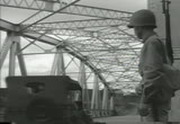
Part two of the Big Picture about the Battle of the Bulge, TIGERS ON THE LOOSE was produced by the Army Pictorial Center and is narrated by Lorne Green. It features live WWII footage and interviews with commanders of the infamous 10th Armored “Tiger” Division. It begins December 16, 1944 as Hitler drives forward (:45-1:08). American defenders at Bastogne are outnumbered and outgunned. General Anthony McAuliffe (1:29) has replied to a letter of surrender with the single word “NUTS.” The 10th Combat Command B and the 101st Airborne have heavy fog, limiting the resupplying of ammunition and medical supplies (1:43-2:24). December 22 was clear, allowing the Air Force to drop supplies (2:35). Brigadier General William Lynn Roberts (2:49) describes a lucky break. A captain in Bastogne was an expert at ground-to-air communications via a VHF set to the Allied planes overhead, dropping napalm bombs, bombs, rockets, and bullets (3:23-4:18). This advantage included seeing enemy tank tracks in the snow (4:21-4:40), shifting the battle. General McAuliffe (4:45) talks about Christmas Eve, when a house with wounded Tigers was completely destroyed (5:30). On December 26, the 4th Armored Division breaks the German line (5:42-5:54). On January 16, 1945, they are officially relieved during a blizzard (6:04), as soldiers fail to get a tank up the hill (6:11-6:32). The 10th leaves town on February 20 to capture Trier (7:58-8:33). Colonel James O’Hara commanded the 54th Armored Infantry Battalion of the 10th (8:39) in the Saar-Moselle triangle (8:48-9:17) and was instructed to cross the Saar River. Company Commander John Devereaux (9:52-11:16) discusses the night crossing, which involved traversing a booby-trapped minefield while under fire. He then explains how pillboxes were cleared (11:47-11:59). The Tigers set off for Trier on February 21, taking shelling (13:15-14:22). The Germans were on the ridges on each side so they crossed at night (16:45-17:39). The next assignment to take a bridge intact caused the tanks to come under heavy fire (18:12-18:44). On March 16, the entire Division pushed towards the Rhine River (18:45-19:00). Colonel Curtis Hankins (19:05) describes destroying an entire German supply train, helped by the Air Force (19:24-19:54). They crossed the Rhine on March 20, capturing 8,000 prisoners (20:02- 20:20). Three days later after heavy fighting, they rolled into Heidelberg (20:23-20:30). The exhausted men take a break (20:36-20:52). The Germans still had armored strength (20:52-21:06). On April 3, the 10th and the 100th Airborne received orders to seize Heilbronn (21:10-21:22). Lieutenant Colonel George Hamel (21:24-22:21) describes an alternative path taken, where more blown bridges halted progress (22:21-22:40). The Germans fought back hard and by April 8, American supplies were low (22:41-22:59). A soldier is loaded into an ambulance (23:00-23:08). The Air Force arrives, dropping temporary supplies (23:11-23:25) but it’s not enough and the Division sadly withdraws between April 11 and April 22 (23:31-23:49). Reaching the Danube River, they joined the 44th Infantry Division in combat (24:24-24:41) and continued capturing towns (25:15). An agreement to not destroy Garmisch-Partenkirchen from the 1936 Winter Olympics was upheld (26:28-27:19). The war ended, the Tigers relax (27:40-28:05) and receive honor (28:07-28:46).
We encourage viewers to add comments and, especially, to provide additional information about our videos by adding a comment! See something interesting? Tell people what it is and what they can see by writing something for example: "01:00:12:00 -- President Roosevelt is seen meeting with Winston Churchill at the Quebec Conference."
This film is part of the Periscope Film LLC archive, one of the largest historic military, transportation, and aviation stock footage collections in the USA. Entirely film backed, this material is available for licensing in 24p HD, 2k and 4k. For more information visit http://www.PeriscopeFilm.com
Human-made No record of this work says a model made it. What this means.
- Archive
- Internet Archive, in Ephemeral films
- Licence or status
- The Internet Archive states none for this item.
- Language
- English
- Who can watch
- The archive gives no rating. Invisible Network shows it to Teens profiles and older, judged from its collection and subjects. How films are placed