1950s U.S. NAVY ICEBREAKER DOCUMENTARY FILM 76934
DocumentaryIndustrial and advertising
Clips are not offered for this film: no licence or public-domain mark is recorded for it.
Low resolution (640×360): this is the archive's own copy.
Parts
About
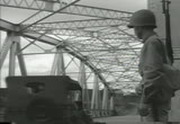
This 1952 U.S. Navy film entitled "Icebreaker" shows a U.S. Navy ship the USS Burton Island traveling from San Diego to Kodiak, Alaska, St. Lawrence and King Island in the Bering Sea. USS Burton Island (AG-88) was a United States Navy Wind-class icebreaker that was later re-commissioned in the United States Coast Guard as the USCGC Burton Island (WAGB-283). She was named after an island near the coast of Delaware, and carried a helicopter on board.
Burton Island's mission in the film was supposedly to survey ice conditions in the Bering Sea, but the ship was also part of an effort by the U.S. Navy to establish a presence in the arctic during the Cold War against the Soviet Union.
A Regulus missile submarine, likely the USS Tunny but possibly USS Cusk, is seen at the 2:45 mark with a hangar on the deck.
Burton Island was one of the icebreakers designed by Lieutenant commander Edward Thiele and Gibbs & Cox of New York, who modeled them after plans for European icebreakers he obtained before the start of World War II. She was the sixth of seven completed ships of the Wind-class of icebreakers operated by the United States Coast Guard. Her keel was laid on 15 March 1946 at Western Pipe and Steel Company shipyards in San Pedro, California, she was launched on 30 April 1946, and commissioned on 28 December 1946.
Her hull was of unprecedented strength and structural integrity, with a relatively short length in proportion to the great power developed, a cut away forefoot, rounded bottom, and fore, aft and side heeling tanks. Diesel electric machinery was chosen for its controllability and resistance to damage. Burton Island was built during peacetime, so she had a much lighter armament than her war-built sisters, one 5 in (130 mm) 38 cal. deck gun and three quad-mounted Bofors 40 mm anti-aircraft autocannons when in Navy service, and unarmed for the Coast Guard.
On 17 January 1947, Burton Island, loaded with supplies, steamed from San Diego to Ross Sea, Antarctica where she met with units of TF 68 on the first Antarctica Development project, Operation Highjump. After returning from Antarctica, Burton Island departed 25 July 1947 for the Point Barrow expedition to Alaska. From April 1948 to December 1956, Burton Island participated in 19 Arctic and Alaskan cruises, including Operation Windmill. During Operation Windmill Burton Island was the flagship of CDR Gerald L. Ketchum, USN commander of Task Force 39. Duties on the cruises varied including, supply activities, helicopter reconnaissance of ice flows, scientific surveys, underwater demolition surveys, and convoy exercises. In March 1949, Burton Island was redesignated AGB-1. One prominent excursion was with the USS Seadragon (SSN-584) and USS Skate (SSN-578) in 1962, in which torpedoes were tested underneath the polar ice pack after the two subs had rendezvoused at the North Pole.
We encourage viewers to add comments and, especially, to provide additional information about our videos by adding a comment! See something interesting? Tell people what it is and what they can see by writing something for example like: "01:00:12:00 -- President Roosevelt is seen meeting with Winston Churchill at the Quebec Conference."
This film is part of the Periscope Film LLC archive, one of the largest historic military, transportation, and aviation stock footage collections in the USA. Entirely film backed, this material is available for licensing in 24p HD and 2k. For more information visit http://www.PeriscopeFilm.com
Human-made No record of this work says a model made it. What this means.
- Archive
- Internet Archive, in Ephemeral films
- Licence or status
- The Internet Archive states none for this item.
- Who can watch
- The archive gives no rating. Invisible Network shows it to Tweens profiles and older, judged from its collection and subjects. How films are placed