"WHY TAKE A CHANCE?" 1950s GENERAL TIRE AUTO ACCIDENT SCARE FILM w/ ART GILMORE 75994
EducationIndustrial and advertising
Clips are not offered for this film: no licence or public-domain mark is recorded for it.
Low resolution (640×360): this is the archive's own copy.
Parts
About
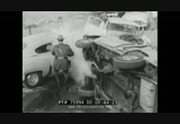
Featuring actor Art Gilmore -- who narrated the 1950s TV show "Highway Patrol", this scare / sales film by General Tire presents the various features of the brand's advanced Nygen cord nylon tubeless tires -- including a pressure lock and water squeegee tread that was revolutionary in its time. The film is notable for showing a variety of sensational car accidents including a car driving off of a cliff (6:40 mark) that might have come from the stock footage library of "Highway Patrol" itself. The film ends with a ridiculous stunt in which a car is dropped off of a ten story building, to demonstrate what a 70 mph impact -- the same as a head-on collision of two cars at 35mph -- looks like.
The General Tire and Rubber Company is an American manufacturer of tires for motor vehicles. General Tire was founded in 1915 in Akron, Ohio, by William F. O'Neil. The company later diversified into a conglomerate, with holdings in tires, rubber compounds, rocketry and aeronautics, entertainment and news, and real estate.
The film emphasizes the critical importance of tire safety, highlighting that every 3 seconds, someone in the U.S. is injured or killed in a traffic accident, with one-third of those fatalities linked to tire-related issues. It underscores the high demands placed on tires today, such as high speeds, rough road conditions, and the need for quick stopping power. The video introduces General Tires' tubeless tires, showcasing their four-way protection system: resistance to blowouts, punctures, pressure loss, and superior stopping ability in both dry and wet conditions. Through dramatic tests and examples, it stresses how General Tires offer more safety and durability than ordinary tires, ultimately urging viewers to choose tires that provide the extra margin of safety needed to avoid serious accidents.
00:00: The ad begins with a dramatic message about the risks of driving with poor tires, emphasizing how accidents can happen in just seconds.
0:55 - 1:33: A shocking statistic is shared: every 3 seconds someone in the U.S. is killed or injured in a traffic accident, with one-third of those fatalities resulting from tire-related issues.
1:33 - 2:22: The ad explains the critical demands placed on tires today, from high-speed driving to rough conditions like snow and potholes, and the importance of tire safety for automobile protection.
2:25 - 3:01: The video stresses the importance of tire checks but questions how many people actually understand their tire’s condition, noting that safety checks are often limited to brakes and lights, not tires.
3:32 - 4:23: Introduction of General's tubeless tire, highlighting its four-way protection features, including resistance to blowouts, punctures, pressure loss, and quick stopping on wet or dry pavement.
4:37 - 5:54: A test is shown where cars with General tires stop much faster than those with competing tires in an emergency, demonstrating the superior stopping power of General tires.
6:00 - 7:01: The ad reinforces the message to not take a chance on unreliable tires, showcasing a scenario where even a small tire issue can lead to a major accident.
7:53 - 8:14: General tires are presented as having superior durability, able to handle shocks and bumps without damage, thanks to their design and safety features like the safety pressure lock.
8:21 - 9:05: The video emphasizes General tires' four-way protection, offering self-sealing latex compounds and the highest safety factors for tire durability and reliability.
Human-made No record of this work says a model made it. What this means.
- Archive
- Internet Archive, in Ephemeral films
- Licence or status
- The Internet Archive states none for this item.
- Who can watch
- The archive gives no rating. Invisible Network shows it to Teens profiles and older, judged from its collection and subjects. How films are placed