Nuclear Weapon Accident training Film "Broken Arrow Procedures" 1962 74892
WarIndustrial and advertising
Clips are not offered for this film: no licence or public-domain mark is recorded for it.
Low resolution (640×360): this is the archive's own copy.
Parts
About
This amazing 1962 U.S. Air Force training film BROKEN ARROW PROCEDURES shows the procedures used in an accident involving a nuclear weapon. In this case, a airborne B-52 has caught fire while carrying a nuclear weapon. The film was likely made in response to the Goldsboro incident of 1961, in which an atomic bomb survived an airplane crash and fire. It was one of the most terrifying moments in the history of the Air Force, SAC and the Cold War, since after the incident it was determined that most of the bomb's safety mechanisms had failed and, in a terrifying scenario, the device could have actually detonated. The incident led to a wholesale reappraisal of safety standards and serves as an enduring lesson to nations that have atomic weapons of the necessity of redundancy with these safety devices.
The film suggests different scenarios, including a nuclear detonation, or a "dirty" fire that presents a hazard to personnel due to nuclear radiation, or a situation in which atomic material is spread over a large area by a crash. In these instances a full scale disaster response, including mass evacuation of personnel and civilians in the area, is needed.
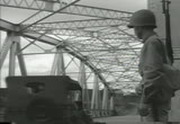
The film includes footage at the 13 minute mark of a B-52 making a hard landing on the runway and its gear collapsing. It also uses b&w footage of a military accident in 1959, with an airplane aflame and first responders arriving on the scene.
The 1961 Goldsboro B-52 crash was an accident that occurred in Goldsboro, North Carolina, on January 24, 1961. A B-52 Stratofortress carrying two Mark 39 nuclear bombs broke up in mid-air, dropping its nuclear payload in the process. The pilot in command ordered the crew to eject, which they did at 9,000 feet (2,700 m). Five men successfully ejected or bailed out of the aircraft and landed safely. Another ejected but did not survive the landing, and two died in the crash. Controversy continues to surround the event as information newly declassified in 2013 reinforced long-held, public suspicions that one of the bombs came very close to detonating.
In 2013, investigative journalist Eric Schlosser published a book, Command and Control, in which he presented a declassified 1969 document obtained under the Freedom of Information Act. In the report, entitled "Goldsboro Revisited," written by Parker F. Jones, a supervisor of nuclear safety at Sandia National Laboratories, Jones says that "one simple, dynamo-technology, low voltage switch stood between the United States and a major catastrophe," and concludes that "The MK 39 Mod 2 bomb did not possess adequate safety for the airborne alert role in the B-52."
We encourage viewers to add comments and, especially, to provide additional information about our videos by adding a comment! See something interesting? Tell people what it is and what they can see by writing something for example like: "01:00:12:00 -- President Roosevelt is seen meeting with Winston Churchill at the Quebec Conference."
This film is part of the Periscope Film LLC archive, one of the largest historic military, transportation, and aviation stock footage collections in the USA. Entirely film backed, this material is available for licensing in 24p HD and 2k. For more information visit http://www.PeriscopeFilm.com
Human-made No record of this work says a model made it. What this means.
- Archive
- Internet Archive, in Ephemeral films
- Licence or status
- The Internet Archive states none for this item.
- Who can watch
- The archive gives no rating. Invisible Network shows it to Teens profiles and older, judged from its collection and subjects. How films are placed