WWII German Army/Pioneers Egineers Building A Ponton Bridge
WarIndustrial and advertising
Clips are not offered for this film: no licence or public-domain mark is recorded for it.
Low resolution (640×360): this is the archive's own copy.
Parts
About
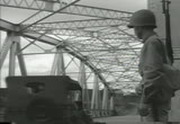
This short silent German educational film shows a unit of German pioneers rapidly constructing a pontoon bridge over a river. A pioneer is a soldier employed to perform engineering and construction tasks. The term is in principle similar to sapper.
Pioneers were originally part of the artillery branch of European armies. Subsequently, they formed part of the engineering branch, in the logistic branch, part of the infantry; or comprised a branch in their own right.
Historically, the primary role of pioneer units was to assist other arms in tasks such as the construction of field fortifications, military camps, bridges and roads. Prior to and during the First World War, pioneers were often engaged in the construction and repair of military railways.
The German Army was the land forces component of the Wehrmacht, the regular German armed forces, from 1935 until it was demobilized and finally dissolved in August 1946. The Wehrmacht also included the Kriegsmarine (Navy) and the Luftwaffe (Air Force). During World War II, a total of about 15 million soldiers served in the German Army, of whom about seven million became casualties. Most army personnel were conscripted.
Only 17 months after Hitler announced publicly the rearmament program, the Army reached its projected goal of 36 divisions. During the autumn of 1937, two more corps were formed. In 1938, four additional corps were formed with the inclusion of the five divisions of the Austrian Army after the Anschluss in March. During the period of its expansion by Adolf Hitler, the German Army continued to develop concepts pioneered during World War I, combining ground (Heer) and air (Luftwaffe) assets into combined arms teams. Coupled with operational and tactical methods such as encirclements and the "battle of annihilation", the German military managed quick victories in the two initial years of World War II, prompting the use of the word Blitzkrieg (literally lightning war, meaning lightning-fast war) for the techniques used.
The German Army entered the war with a majority of its infantry formations relying on the horse for transportation. The infantry remained foot soldiers throughout the war; artillery also remained primarily horse-drawn. The motorized formations received much attention in the world press in the opening years of the war, and were cited as the main reason for the success of the German invasions of Poland (September 1939), Norway and Denmark (April 1940), Belgium, France and Netherlands (May 1940), Yugoslavia (April 1941) and the early campaigns in the Soviet Union (June 1941). However their motorized and tank formations accounted for only 20% of the Heer's capacity at their peak strength.[citation needed] The Heer's lack of trucks (and petroleum to run them) was a severe handicap to infantry movement especially during and after the Normandy invasion when Allied air power devastated the French rail network north of the Loire. Panzer movements also depended upon rail: driving a tank over 150 kilometers wore out its tracks.
Separate from the army, the Waffen-SS (Armed SS) was a multi-ethnic and multi-national military force of the Third Reich. Growing from three regiments to over 38 divisions during World War II, it served alongside the army but was never formally part of it.
This film is part of the Periscope Film LLC archive, one of the largest historic military, transportation, and aviation stock footage collections in the USA. Entirely film backed, this material is available for licensing in 24p HD and 2k. For more information visit http://www.PeriscopeFilm.com
Human-made No record of this work says a model made it. What this means.
- Archive
- Internet Archive, in Ephemeral films
- Licence or status
- The Internet Archive states none for this item.
- Who can watch
- The archive gives no rating. Invisible Network shows it to Teens profiles and older, judged from its collection and subjects. How films are placed