" ARMY / NAVY SCREEN MAGAZINE " WWII STEAM LOCOMOTIVES, JAPANESE NEWSREEL, THE FIGHTING DUTCH 71832
WarNewsIndustrial and advertising
Clips are not offered for this film: no licence or public-domain mark is recorded for it.
Low resolution (640×360): this is the archive's own copy.
Parts
About
This newsreel is part of the Army/Navy Screen Magazine, a WWII newsreel program produced from June 1943 until early 1946 by the Army Signal Corps under the supervision of director Frank Capra. It includes several segments. First, "Iron War Horse" which shows the operational training of troops at Camp Claiborne, Louisiana to maintain railroads at the battle front. "Seized from the Japs" shows rare captured Japanese military newsreel films, including an amphibious assault. It shows their training and amphibious maneuvers, with the narrator emphasizing their savagery and obstinacy. Finally "The Fighting Dutch" shows the people of Holland and their response to the German invasion, with Free Dutch forces joining the Allied fight -- training in Mississippi to fly P-40 Warhawks and other aircraft, and manning Dutch transport ships in the South Pacific and Africa. The historical context of Holland's peace and subsequent invasion by Germany and Japan is discussed, along with the Dutch government's exile and resistance efforts. Dutch soldiers train in Canada and the U.S., preparing to fight for their homeland. Their missions include patrolling sea lanes and contributing to Allied efforts in various theaters. The text concludes with a focus on the Dutch people's resilience and determination to fight for freedom, maintaining their customs and traditions while training abroad. (The Netherlands entered World War II on May 10, 1940, when invading German forces quickly overran them. On December 7, 1941, after the attack on Pearl Harbor, the Netherlands government in exile also declared war on Japan. Operation Market Garden, which started in 1944, liberated the southern and eastern parts of the country, but full liberation did not come until the surrender of Germany on May 5, 1945.)
• 0:07-0:28: Introduction with music.
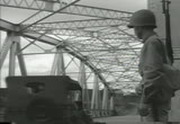
• 0:30-1:00: Importance of rail transportation in combat areas and training railroad battalions.
• 1:00-1:30: Soldiers learn railroading the Army way at Camp Clayborn.
• 1:30-2:00: Soldiers practice on a 50-mile strip of track, working under combat conditions.
• 2:00-2:30: Repair crews respond to damage, traveling by trucks and hand cars.
• 2:30-3:00: Bulldozers and flat cars repair bombed tracks, vital for supply lines.
• 3:00-3:30: Importance of railroads in maintaining supply lines in Africa and Europe.
• 3:30-4:00: Captured Japanese film shows their training and amphibious maneuvers.
• 4:00-4:30: Japanese soldiers' training and their use of natural terrain for cover.
• 4:30-5:00: Comparison of Japanese and Allied training, highlighting Japanese savagery and obstinacy.
• 5:00-5:30: Japanese fortification of small islands as outermost defense.
Human-made No record of this work says a model made it. What this means.
- Archive
- Internet Archive, in Ephemeral films
- Licence or status
- The Internet Archive states none for this item.
- Who can watch
- The archive gives no rating. Invisible Network shows it to Teens profiles and older, judged from its collection and subjects. How films are placed