SINKING OF THE GERMAN BATTLECRUISER GRAF SPEE NEWSREEL 70702
NewsIndustrial and advertising
Clips are not offered for this film: no licence or public-domain mark is recorded for it.
Low resolution (640×360): this is the archive's own copy.
Parts
About
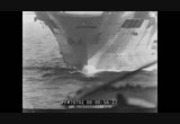
This 1939 sound newsreel vividly shows the sinking of the German heavy cruiser Admiral Graf Spee.
Admiral Graf Spee was a Deutschland-class heavy cruiser (originally termed Panzerschiff or armoured ship, sometimes referred to as "pocket battleship") which served with the Kriegsmarine of Nazi Germany during World War II. The vessel was named after Admiral Maximilian von Spee, commander of the East Asia Squadron that fought the battles of Coronel and Falkland Islands in World War I. She was laid down at the Reichsmarinewerft shipyard in Wilhelmshaven in October 1932 and completed by January 1936. The ship was nominally under the 10,000 long tons (10,000 t) limitation on warship size imposed by the Treaty of Versailles, though with a full load displacement of 16,020 long tons (16,280 t), she significantly exceeded it. Armed with six 28 cm (11 in) guns in two triple gun turrets, Admiral Graf Spee and her sisters were designed to outgun any cruiser fast enough to catch them. Their top speed of 28 kn (52 km/h; 32 mph) left only a handful of ships in the Anglo-French navies able to catch them and powerful enough to sink them.
The ship conducted five non-intervention patrols during the Spanish Civil War in 1936–1938, and participated in the Coronation Review for King George VI in May 1937. Admiral Graf Spee was deployed to the South Atlantic in the weeks before the outbreak of World War II, to be positioned in merchant sea lanes once war was declared. Between September and December 1939, the ship sank nine ships totaling 50,089 gross register tons (GRT), before being confronted by three British cruisers at the Battle of the River Plate on 13 December. Admiral Graf Spee inflicted heavy damage on the British ships, but she too was damaged, and was forced to put into port at Montevideo. Convinced by false reports of superior British naval forces approaching his ship, Hans Langsdorff, the commander of the ship, ordered the vessel to be scuttled. The ship was partially broken up in situ, though part of the ship remains visible above the surface of the water.
This film is part of the Periscope Film LLC archive, one of the largest historic military, transportation, and aviation stock footage collections in the USA. Entirely film backed, this material is available for licensing in 24p HD. For more information visit http://www.PeriscopeFilm.com
Human-made No record of this work says a model made it. What this means.
- Archive
- Internet Archive, in Ephemeral films
- Licence or status
- The Internet Archive states none for this item.
- Who can watch
- The archive gives no rating. Invisible Network shows it to Teens profiles and older, judged from its collection and subjects. How films are placed